
EPA rollbacks push the South toward dirtier air and higher health risks
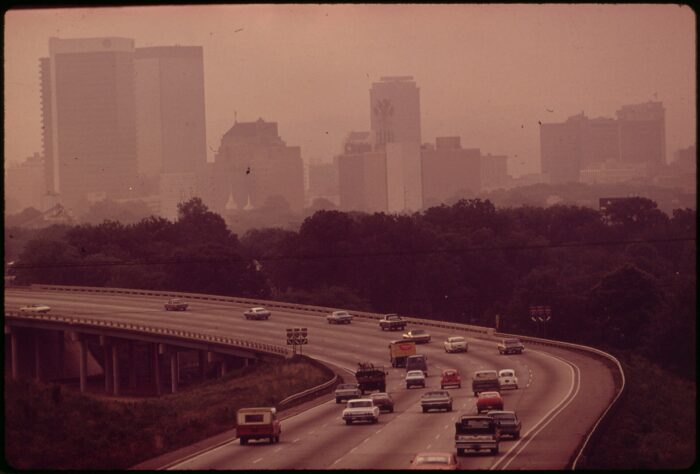
Imagine Birmingham, Alabama, before clean air laws, when the city’s steel mills and coke plants belched smoke so thick that it left the skyline in a haze and coated neighborhoods with soot. This poor air quality earned Birmingham the unsavory moniker, “Smoke City.”
In rural Appalachia, coal dust settled on mining towns and unregulated chemical pollution left toxic odors hanging in the air in cities and towns across the South.
By 2020, the Clean Air Act had prevented 230,000 premature deaths annually. It has reduced asthma attacks, heart disease, and respiratory illness. The economic benefits are at least 30 times what they cost to implement.
“The Clean Air Act, at its core, is a public health law,” said SELC’s Air Program Leader Keri Powell in her September 2025 testimony defending the Clean Air Act before the House Energy and Commerce Subcommittee. She emphasized that strong clean air protections are implemented through permits.
“Rather than weakening this essential tool for protecting air quality, Congress should be providing more support to state and local agencies charged with issuing and enforcing air permits. They need technical and scientific support, legal support, and funding,” Powell testified. “What they do not need are fuzzy requirements full of loopholes that prevent them from issuing strong permits that help them protect public health in their communities.“
No one voted for dirty air
The Trump administration’s assault on environmental protections threatens to take us back to these dangerous conditions before the 1970 passage of the modern Clean Air Act.
With only an email, some of the nation’s biggest polluters have been granted presidential exemptions, providing them with a pass from complying with the law while the Environmental Protection Agency (EPA) seeks to weaken federal hazardous-air-pollutant limits across the board. The Trump administration isn’t just bending the rules — it’s opening the door to the past we fought so hard to leave behind.
Clean air isn’t a privilege; it’s a basic right.
Keri Powell, SELC’s Air Program Leader
Since the start of the second Trump administration in early 2025, EPA has rolled back some of our most basic clean air protections, including:
- Loosening emissions rules for cars and trucks,
- Ignoring deadlines to implement tighter limits on fine particle pollution (soot),
- Weakening standards for new power plants, and
- Announcing it will stop factoring in the health and economic harms from some of the most toxic and dangerous pollutants when making new regulations.
Our air quality is getting worse
Poor air quality is exacerbated by climate change. With a warming climate and fewer regulations, air quality has been steadily deteriorating for millions of Americans, according to the American Lung Association’s 2026 “State of the Air” report.
Following historic patterns, the report underscores that exposure to dirty air is not equal: much of the toxic burden is placed on Black, Brown, and communities earning a lower income.
Report findings at a glance:
- Communities of color are more than twice as likely to live in areas with polluted air,
- Approximately half of the nation’s children — or 33.5 million — are exposed to harmful levels of air pollution, and
- More than 7 million children, or 10% of all kids, live somewhere that failed every air quality measure.
EPA’s own data tells a similar story. Air pollution spikes from coal-fired power plants in 2025 led to emissions levels rising at one of the sharpest percentage rates in a quarter‑century, as the majority of about 210 power plants recorded increases in sulfur dioxide and nitrogen oxide pollution.
Sulfur dioxide emissions rose more than 18%, climbing from 597,000 tons in 2024 to 705,000 in 2025. Nitrogen oxide emissions from coal plants increased about 12%, from 464,000 to 521,000 tons. Both of these pollutants can exacerbate asthma, reduce lung function, and increase risks of heart disease.
Our communities and families deserve clean air. SELC is working alongside our local and national partners to block these harmful rollbacks. Here’s how we’re fighting back.
Addressing soot pollution problems
As the Trump administration inflicts more harm on local communities through delay and inaction on deadly soot pollution, we are asking a federal court to hold EPA accountable for implementing its own strengthened standard that will save thousands of lives.
EPA has estimated that the strengthened standard would prevent up to 4,500 premature deaths annually, avoid 800,000 cases of asthma symptoms and 2,000 emergency room visits, and yield up to $46 billion in net health benefits once implemented.
The federal agency’s failure to implement the standard by the legal deadline puts communities at greater risk of breathing in more deadly pollution that can cause asthma, lung disease, heart attacks and coronary heart disease, depression and suicide, preterm births, and premature death.
Upholding strong Mercury Air Toxics Standards
The lifesaving Mercury and Air Toxics Standards have already reduced toxic mercury emissions by 90% from the power sector, protecting the health of children and communities across the country.
Restrictions on mercury and air toxics from power plants are commonsense health protections that utilities have already largely complied with. Nonetheless, the Trump administration is dismantling them.
On March 30, SELC, representing national public health organizations, filed a lawsuit along with 12 other health, environmental, and community groups to challenge EPA’s repeal of updated limits on mercury and air toxics from power plants finalized in 2024.
Confronting the ethylene oxide emergency
SELC is working to better protect communities from ethylene oxide pollution — a toxic, cancer‑causing gas used in industrial sterilization — by challenging the administration’s illegal use of presidential exemptions allowing commercial sterilizer facilities to sidestep stronger federal standards and forgo pollution controls, which some of them are already using. We are also pushing back against the administration’s plans to weaken the federal standards.
Clean air progress for all is possible
The path to clean air is clear: When strong protections are in place and enforced, communities across the South and nation breathe better.
“Clean air isn’t a privilege; it’s a basic right,” says Powell. “We’re fighting every day to make sure every community can claim it.”
By challenging unlawful pollution, defending science-based standards, and pushing for accountability, SELC is helping ensure that everyone, no matter where they live, has the chance to breathe healthy, safe air.