
Turning community concern into a fight for clean air
When Georgia resident Janet Rau first learned that a sterilization facility near her community was releasing ethylene oxide, a toxic gas linked to cancer, she wasn’t looking to start a movement. She was trying to understand what was happening where she lived and worked. Media coverage highlighted the elevated cancer risks near certain industrial facilities. What stood out wasn’t just the data, it was how close to home it felt.

“It suddenly gave context to things we’d been seeing for years,” Rau says, pointing to a troubling number of cancer cases among teachers and staff at the school in the Atlanta suburbs where she worked.
“It was people we knew. People our kids knew.”
At the time, Sterigenics, a company with commercial facilities across the country that use ethylene oxide (EtO) to sterilize medical equipment, was operating quietly in the community. Like many residents, Rau assumed that any facility that posed a real danger would never be permitted in the first place. That assumption didn’t last long.
From awareness to action
Early conversations played out in Facebook groups, where neighbors began sharing articles, personal stories, and questions. What started as a few hundred concerned residents quickly grew.
Rau stepped into a leadership role as the group expanded, helping organize what would become the grassroots group Stop Sterigenics GA. Committees formed around individuals’ expertise: legal, scientific, communications, and research. Volunteers dug into regulatory filings, emissions data, and the history of the facility and surrounding land.
One of the group’s earliest priorities was debunking common myths, particularly the idea that household air filters could protect families from EtO exposure. “That’s simply not true,” Rau says. “This isn’t something you can filter out with a HEPA unit. People needed clear, honest information.”
Learning from others and looking beyond one neighborhood
As Stop Sterigenics GA gained traction, organizers connected with advocates in Willowbrook, Illinois, where community pressure had already forced a Sterigenics facility to shut down. That relationship proved pivotal.
“They understood the corporation’s playbook,” Rau says. “They helped us anticipate what arguments would be made and how the process would unfold.”
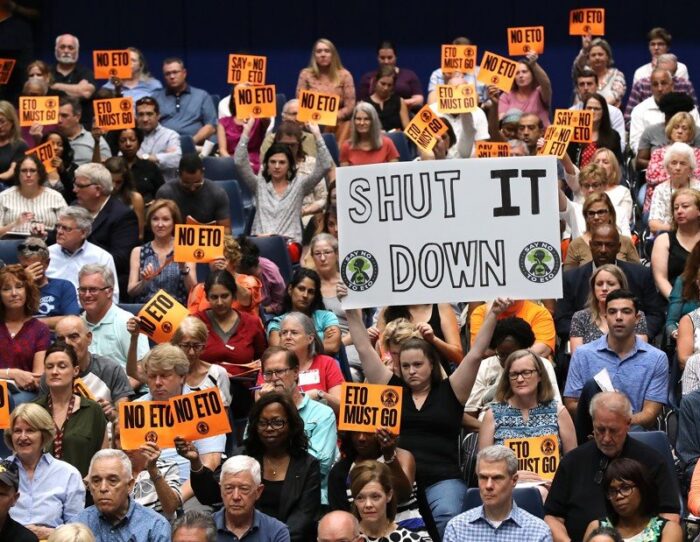
Those lessons shaped the group’s strategy in Georgia, from town halls to regulatory engagement.
It also helped clarify a broader goal to make their effort about more than one facility or one ZIP code. Rau is careful to reject a “not-in-my-backyard” framing, noting they’ve tailored their efforts to make sure these facilities aren’t in anyone’s backyard. That’s especially important because of the pattern of placing sterilization facilities in low-wealth communities and Black and Brown neighborhoods, where developers assume they’ll face less resistance. Instead, Rau’s group is pushing for the industry to adopt proven, available technology that dramatically cuts down on emissions wherever they’re located.
“This is about who gets protected and who doesn’t,” she says. “You have to look at the whole map and consider who is downwind.”
Soon school systems and government agencies began conducting air testing. The issue moved from neighborhood conversations to public accountability. Eventually public disclosure measures were secured at the state level in response to public outcry and strong advocacy.
Federal rollbacks and renewed urgency
Just as momentum built in Georgia, the national political landscape shifted. In 2025, the Trump administration granted Sterigenics, and 39 other commercial sterilizers nationwide, a presidential exemption from complying with stronger federal air pollution standards established in 2024. This effectively allows the facility near Janet’s school to operate for two additional years without running the upgraded pollution controls it has already installed.
For communities already navigating years of advocacy, the exemption felt like a setback and a reminder of how fragile federal protections can be. “It shifted responsibility back onto states and local governments,” Rau says. “And it made clear that some of the work we thought was done…wasn’t.”
Rather than disengage, organizers recalibrated.
The focus turned to local and state-level action: zoning, permitting, and pressure on elected officials to uphold the stronger 2024 standards despite federal rollbacks.
Taking the long view
Today, Rau describes the work as ongoing. It is less about a single win and more about sustained vigilance. What gives her hope, she says, is the people. “There are still brilliant, committed folks involved,” she says. “People who understand this is long-term work.” Change isn’t fast, but it is cumulative. And for Rau, that may be the most important lesson of all: informed communities, grounded in facts and supported by strong partnerships, can reshape what’s possible, even when the odds are stacked against them.