

Four reasons your energy bills are going up
As we head into the warmest months of the summer, rising energy costs are top of mind for many Southerners. Many will have to make the hard choice between paying for medicine, food, rent, and keeping the cold air on.
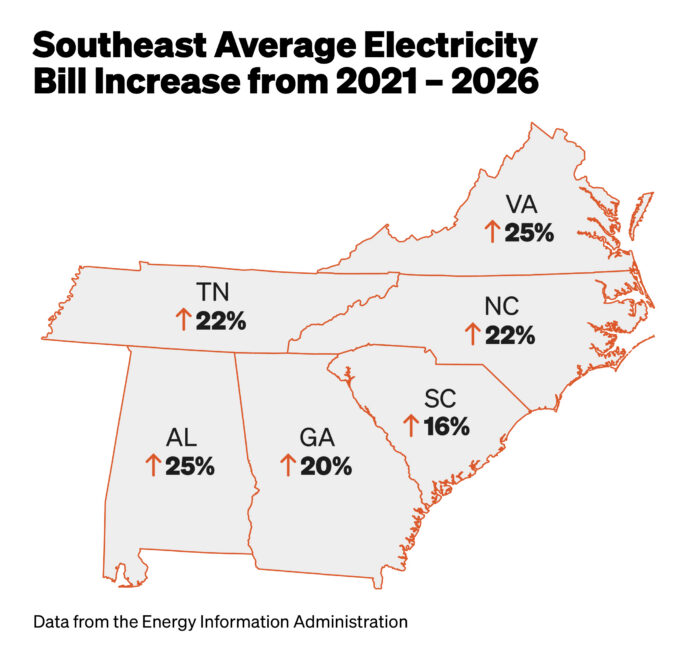
In Virginia, electricity bills have risen by more than 25% over the past five years. These price increases hit many Southerners hardest because the problem is compounded in the region due to high energy burdens and large wealth inequalities. More than a third of the region’s population struggles to pay their energy bills.
Tell your member of Congress to support the Energy Bills Relief Act.
Although skyrocketing bills are happening due to a myriad of reasons across the country like inflation, extreme weather, and increasing electricity demand, in the Southeast this is compounded by a unique set of factors. In this piece, we’ll explore how the region’s utility business model, the explosion of data centers, fossil fuel risks, and recent decisions by the Trump Administration contribute to rising energy prices in the Southeast and what can be done about it.

Data centers
In the Southeast there is a proliferation of data centers that is increasing energy demand and, in turn, energy bills for many communities. Data center companies have targeted the South because of the region’s tax incentives, lax regulations, and affordable land. There are currently 500 existing data centers and proposals for 200 more in SELC’s six-state region alone.
Data centers need electricity to power their servers and operate cooling systems. Hyperscale data centers often require over 100 megawatts of power, roughly equivalent to the energy demand of 80,000 homes. And data centers are driving much of the projected electricity demand, or “load growth,” in the South—for example, Georgia Power says data centers will account for at least 80% of its load growth over the next five years.
To meet the increasing projected demand for electricity, utilities in the region are building new gas plants and other grid infrastructure and planning to delay coal retirements and keep running their aging, expensive-to-operate coal plants. These projects, such as building a new gas plant, can cost ratepayers over a billion dollars, which is shared across the entire customer base. As data centers join the grid, electricity prices surge, raising costs for everyday customers.
These costly infrastructure projects are a win-win for utilities, as they generate profits by building expensive new infrastructure like power plants and power lines, then earning a generous return on those investments and recovering the costs from ratepayers. Utility companies across the South are looking to cash in on the data center ‘gold-rush’ and ratepayers will foot the bill.
Fossil fuel risks
Across six southern states, utilities have proposed adding 45,000 megawatts of new gas generation, dozens of new plants, by 2040 to meet demand from tech companies and their power-hungry data centers.
Methane gas is a costly and volatile fuel. Gas prices can wildly fluctuate and are susceptible to market spikes due to overseas war or winter storms. Further, to turn a fossil fuel like methane gas into energy, you have to pay for the fuel. But for renewable energy sources like wind and solar, the fuel is free.
Rather than investing in low-cost renewable resources like solar, battery storage, and energy efficiency, which are quicker and less expensive to bring online, utilities continue to make risky investments in methane gas.
Utility business model
In the Southeast, energy is mostly provided by investor-owned monopoly utilities regulated by the government. Due to the structure of most utilities, ratepayers have little say in which energy resources are built to meet energy demand.
Utilities prefer to build expensive projects like gas plants because regulators approve a return on their capital investments. Utilities earn 9-10% on investments in gas plants and then pass the costs on to ratepayers. Customers also often pay for expensive infrastructure upgrades like power lines, even when the utility has more cost-effective solutions available. Due to this excessive return-on-equity (ROE) system, utilities are incentivized to overinvest in construction projects like methane gas plants.
For example, Georgia Power intends to build eight brand new methane gas units in the hopes that projected data center demand will materialize, this is expected to cost ratepayers tens of billions of dollars in costs for decades to come.
Utilities can help reduce energy bills by investing in renewable energy technologies and energy efficiency programs, rather than dirty fuels like methane gas and coal. Electric utilities have a legal obligation to keep costs as low as possible for their customers and should be relying on technology that keeps prices low.
Recent reports show that 99% of coal plants in the U.S. are more expensive to run than replacing them with local renewable energy like solar, wind, and battery storage. (Energy Innovation)
The Trump administration
The Trump administration’s attacks on clean energy and Congress’s repeal of tax credits are hiking Southerners’ energy bills, reducing energy freedom and access to homegrown energy.
In 2022, Congress provided $7 billion for the Solar for All Program, which the U.S. Environmental Protection Agency (EPA) used to award grants to organizations and states nationwide to increase access to solar and provide energy bill relief to over 900,000 households. The Trump administration unlawfully terminated the program, which would have guaranteed 20% savings on electricity bills for participating households.
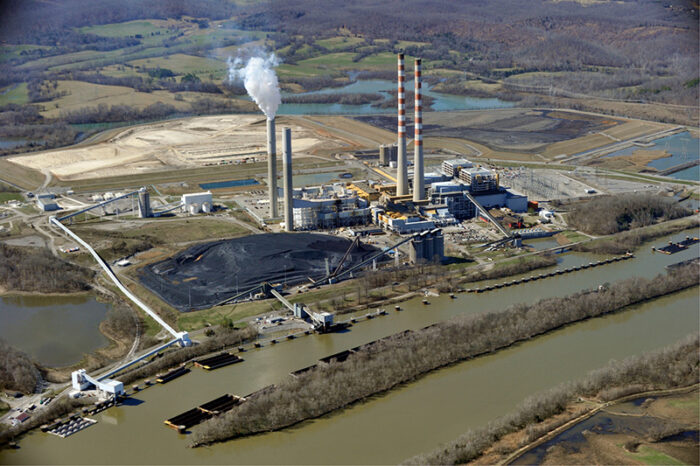
In a last-ditch effort to save the dying coal industry, Trump has also called for delaying the closure and funding upgrades of coal plants, which are notoriously expensive to operate and produce energy. Recent reports show that 99% of coal plants in the U.S. are more expensive to run than replacing them with local renewable energy like solar, wind, and battery storage. Across the South, a handful of coal plants are now expected to delay retirement.
These efforts have undone decades of progress and is increasing cost for American families to help polluters make more profits. Families need pro-clean energy policies that will help them save money on their energy bills.
Standing up for Southerners
As the cost-of-living rises, many Southern families are feeling the pressure of higher energy costs. SELC is working to ensure that utilities save customers money and we’re taking on the Trump administration.
We sued the Trump administration after it terminated the Environmental and Climate Justice Block Grant Program, which would have helped lower families’ energy costs. In June, a federal court ruled that the termination was illegal. In South Carolina, SELC and other clean energy groups reached an agreement with Dominion Energy that would lower Dominion’s proposed rate increase and secure $6 million in shareholder commitments for customer assistance and low-income weatherization programs.