

Resources for engaging at the Georgia Public Service Commission
Energy work at the Public Service Commission can be wonky and sometimes mysterious. This page provides resources to make engaging with Georgia’s PSC a little easier.
Overview: Regulation of Georgia Power
Georgia Power Company is an investor-owned utility that functions as a monopoly in its defined service territory in Georgia. It is one of over a dozen subsidiaries of the publicly traded company Southern Company. (Other subsidiaries include Alabama Power, Mississippi Power, Atlanta Gas Light, Southern Nuclear, and Southern Company Services.) It is regulated by the Georgia Public Service Commission (PSC), a regulatory body made up of five elected officials and a staff of approximately 90 experts, lawyers, and administrators.
Georgia is one of 10 states that elects its utility regulating body. Commissions in most states are appointed by a governor, or a combination of the governor and state legislative body. Learn more about public utility commissions here.
Links to the PSC’s website:
Key Dates
To open entire Google Sheet in new tab, click here. For hidden rows (starting January 2025), contact Bailey Shea at [email protected].
Data Center Fuel Costs (RTP)
The 2026 Fuel Cost Recovery docket revealed that new large load customers — including data centers — which pay for furl through the “RTP” (Real Time Pricing) tariff are not paying towards important, huge categories of fuel costs. (See GIPL & Southface Post-Hearing Brief in FCR-27 docket for more details.)
Fuel Cost Recovery (FCR-27) and Storm Cost Recovery
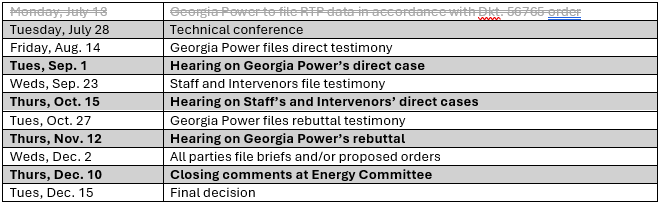
In February 2026, Georgia Power filed in two separate dockets to ask the PSC to recover from customers (read: charge customers for) the costs of fuel (e.g., methane gas, coal) and costs incurred from major storms (e.g., Hurricane Helene). The key dates in each case are listed under the “schedules” tab below.
| Fuel Cost Recovery (FCR-27) Docket (#56765) | |
| Storm Cost Recovery (“Rate Freeze”) Docket (#44280) | |
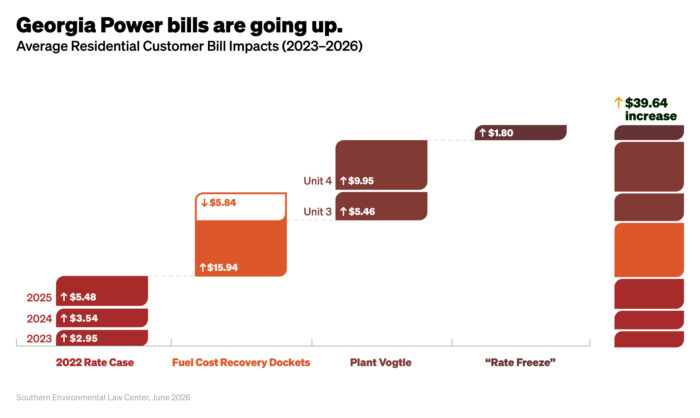
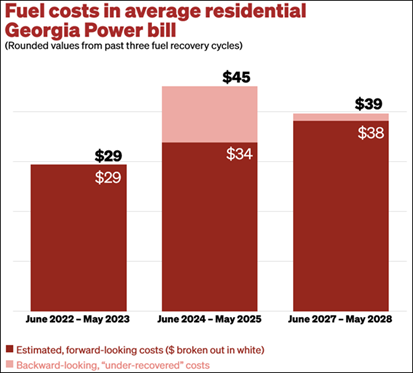
As part of everyone’s power bill, Georgia Power charges customers for its anticipated costs to deal with the damage from storms. Typically, if the company underestimated these costs, it would ask the PSC to recover those costs by making an adjustment to rates in a “rate case” – a major litigated proceeding, historically roughly every three years. In a rate case, storm is just one of many components of rates that are adjusted.
So why are we having a “storm docket” now?
- You may recall that Georgia Power and the Public Service Commission’s Staff struck a deal in May 2025 to, in their words, “freeze base rates.” The way they accomplished this was to ensure that no rate case would happen in 2025, as had been anticipated for the past three years. The next rate case is now expected (though not legally mandated) to occur in 2028.
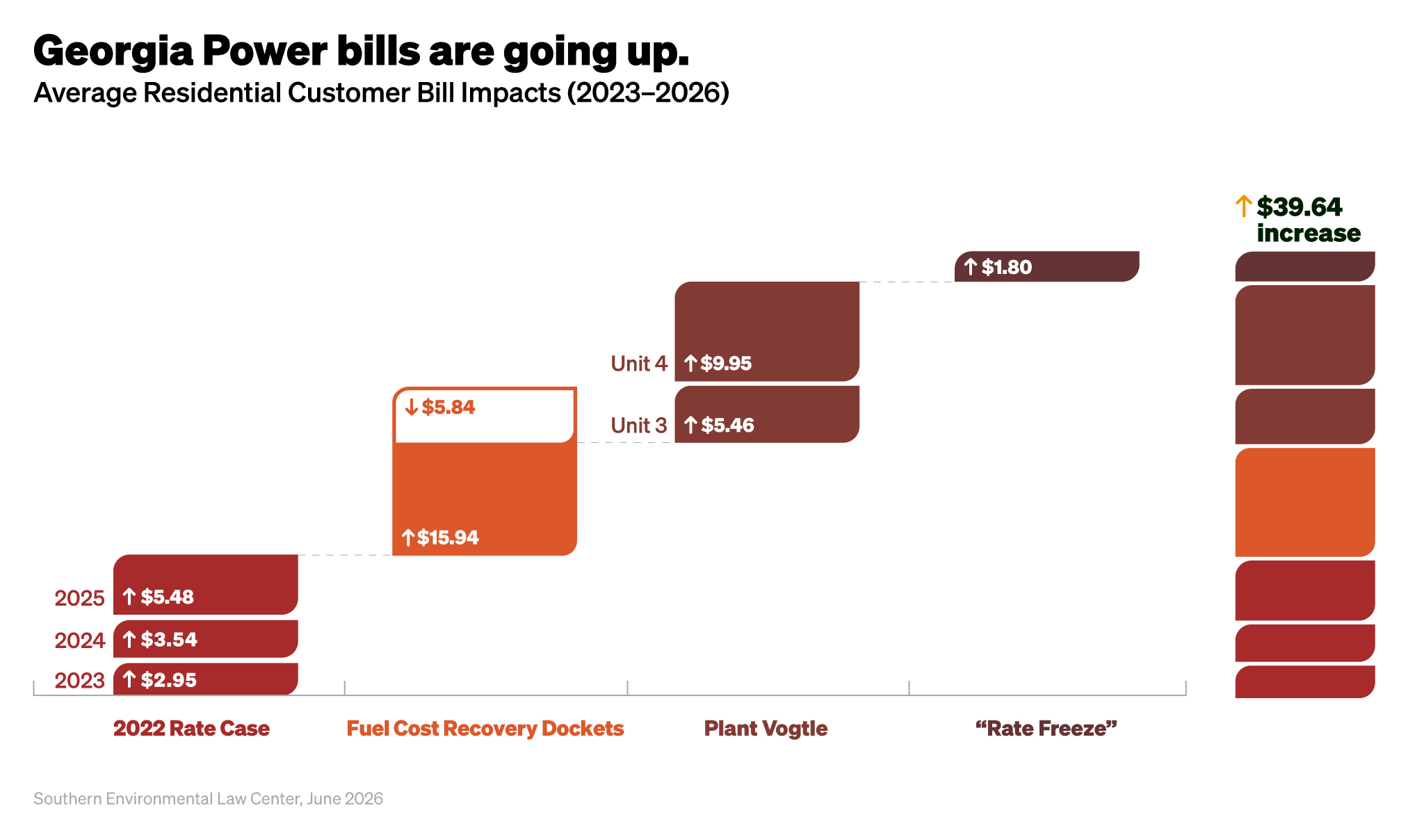
- There were a few exceptions to this kicking of the “rate case” can down the road—storm costs were one of them. The damage caused by Hurricane Helene caused costs to Georgia Power. Instead of waiting until a future rate case to adjust rates to recover those under-recovered (unanticipated) costs from major storms including Helene, the settlement required that Georgia Power file to do so in 2026.
You read that right: The “rate freeze” from last year was actually an increase in the average residential bill.
Georgia Power has proposed to earn profit on these charges.
Georgia Power’s Application for Certification of “All-Source RFP” and “Supplemental” Resources (10 GW Request)
10 GW request
On August 30, 2025, Georgia Power filed applications for certification of nearly 10 gigawatts of generation resources through two new dockets:
- 56298 – Application for the Certification of the 2029-2031 All-Source Capacity RFP (7,999 MW)
- 56310 – Application for the Certification of Supplemental Resources for 2028-2031 Capacity (1,886 MW)
You may recall that resources from the All-Source RFP docket were discussed during the 2025 IRP. In the end, the IRP final order stipulated that Georgia Power “shall be authorized to seek certification of up to 8,500 MW of capacity from the 2029-2031 All Source Capacity RFP.” (emphasis added)
Georgia Power’s request for certification of “supplemental resources” was made in a separate docket. Both are being handled together this fall as laid out in the Procedural and Scheduling Order available here.
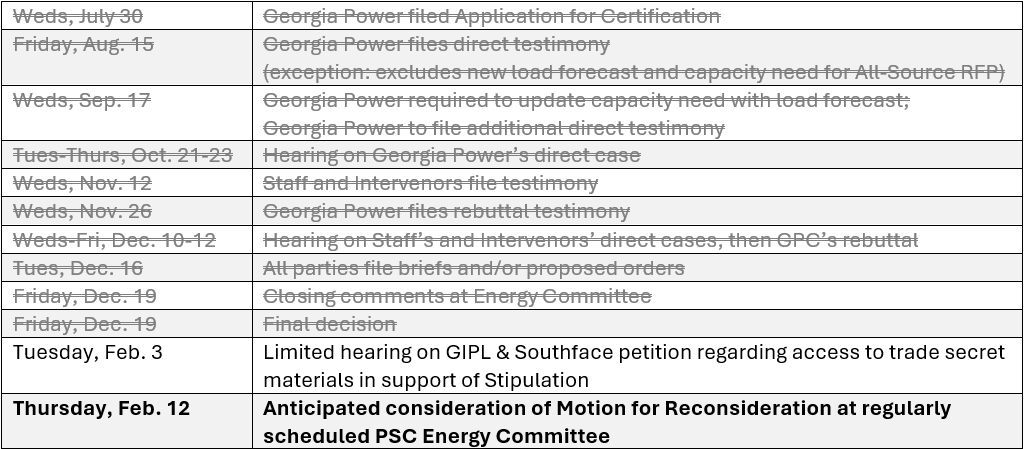
GIPL (Georgia Interfaith Power & Light), Southface, Sierra Club, and SACE (the Southern Alliance for Clean Energy) filed a motion for reconsideration in “the 10 GW docket” at the Public Service Commission.
Georgia Power testimony and updated load forecast available here and here.
Resources
2025 Integrated Resource Plan
generally
2025 IRP
key filings
visualizations
At least every three years, Georgia Power is required by statute to file an “integrated resource plan” (IRP) with the Public Service Commission and then undergo a litigated quasi-judicial proceeding. In short, the IRP seeks to answer the questions: “How much electricity do we need?,” and “How will we generate and provide that electricity?”
Learn all about the IRP through trainings provided by Georgia Interfaith Power & Light and Southface, available here.
You can see the detailed schedule of hearings and deadlines in the “Procedural and Scheduling Order” (PSO) here. Filings are publicly available in docket #56002 on the PSC website. The main IRP filing is here. Here is a table of contents to guide you through it. Expand this section for more detail. All public disclosure documents filed in the IRP are filed with the PSC and are available on public online docket pages. (Some information may be deemed “trade secret” by Georgia Power. In these cases, redacted “public disclosure” versions are filed publicly.) The 2025 IRP is actually referred to as an “Integrated Resource and Demand-Side Management Plan.” This means that it technically is filed in two parts, in one docket as the IRP, and in a separate docket for the DSM plan. (The IRP docket is all that most people will need.) The docket numbers are 56002 (IRP) and 56003 (DSM).
Main filing – Download the main document here. The entire file with technical appendices is here. The accompanying DSM filing is here.
Testimony – Summary table of testimony filed by the PSC’s Public Interest Advocacy Staff and by 13 (of 20 total) Intervenors. Click here.
Transcript access – Fifteen interested parties sent a letter to commissioners regarding transcript access on April 22, 2025. That letter is available here.
A few intervenors have blog posts about their testimony. (Click to expand.)
Southern Alliance for Clean Energy
Georgia Power’s Assumptions for Data Center Growth Could Cost Customers Billions, Increase Pollution
Georgia Power is planning to update the power grid. Are its customers getting a good deal?
Southern Renewable Energy Association
Let the Market Lead: Aligning Georgia’s Energy Plan with Business Demand and Economic Growth
Georgia Power’s response to Staff data request re IRA and IIJA investments.
Staff data request JKA-1-19 asks Georgia Power about how this IRP incorporates investments under the Infrastructure Investment and Jobs Act (“IIJA”) and Inflation Reduction Act (“IRA”). Response available here.
Plant Bowen new methane gas plant – air permit application
On March 5, 2025, Georgia Power filed an air permit application with the Environmental Protection Division to build 4 new methane gas combined-cycle units at Plant Bowen. (No, these were not mentioned in the IRP.)
The application documents are available at the Georgia Environmental Protection Division’s “GEOS” system here.
To search for Plant Bowen, type “Bowen” into the search field for Facility Name and select “Air” for the search field for Department. The first result “905935 – Title V Application (for Renewals & Modifications of Title V Sources)” dated March 5, 2025 is the air permit application.
EPD’s comment period for the permit application ends April 11.
Plant Wansley new methane gas plant units – air permit application
On June 11, 2025, Georgia Power filed an air permit application with the Environmental Protection Division to build 2 new methane gas combined-cycle units at Plant Wansley. (Like the proposed units at Plant Bowen, these were not mentioned in the IRP.)
The application documents are not available online at EPD’s GEOS system, but the main document is available here.
EPD’s comment period for the permit application ends July 11.
Data visualizations (accurate only for IRP; no longer current)
(Click on image to see full-size in a new tab.)
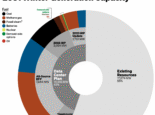
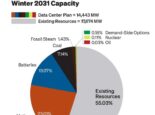
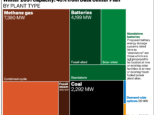
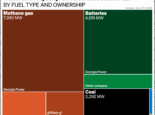
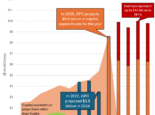
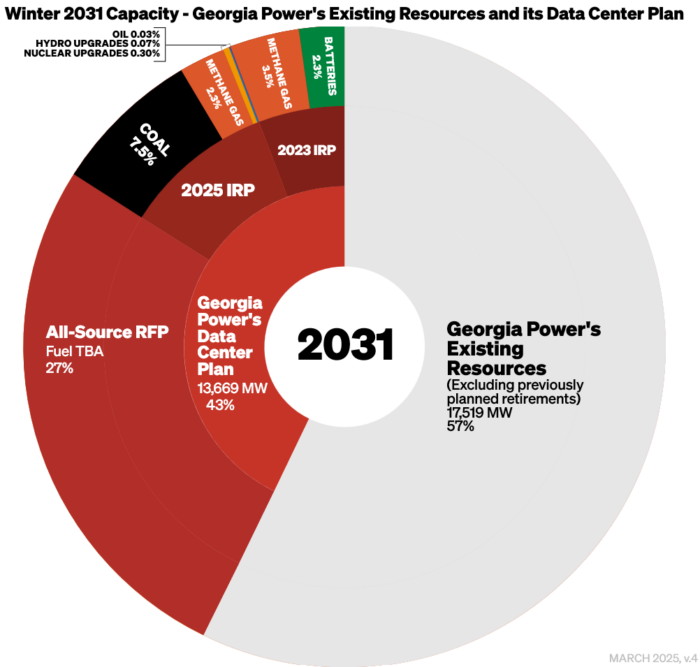
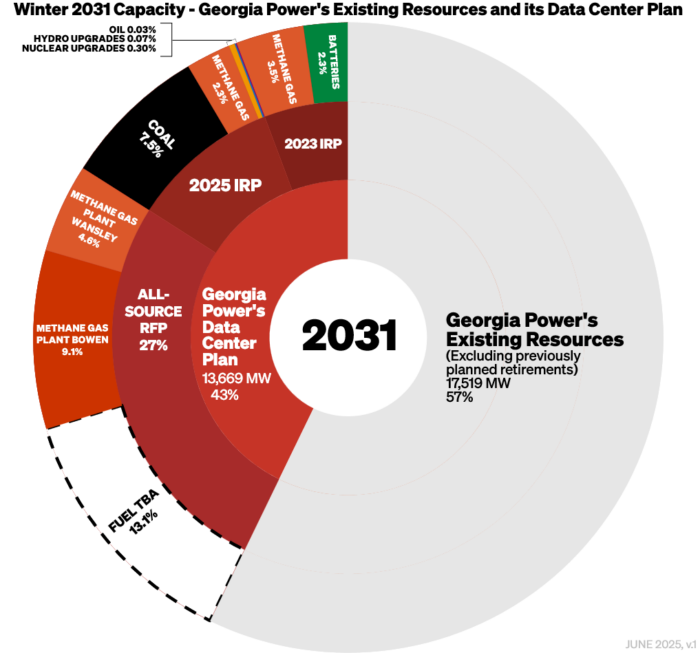
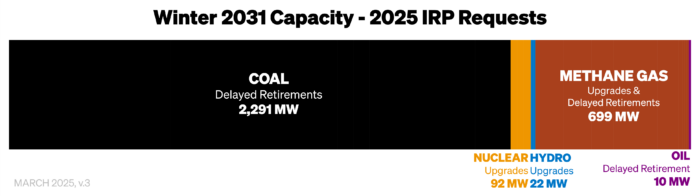
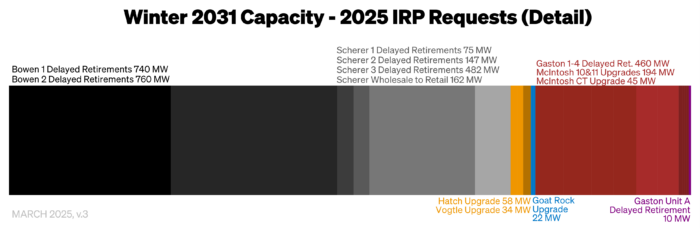
If Georgia Power’s projected growth is approved by the Commission as-is, it will require a massive expansion of the entire Georgia Power system by 2031. In the above pie chart, “Data Center Plan” refers to Georgia Power’s projections for the needs of new large load customers (mostly recruited by Georgia Power to its system) since 2022, and its proposals to meet that need. This includes: 2023 IRP Approvals, 2025 IRP Requests (including delayed coal and gas retirements), and resources procured in its All-Source RFP that won’t be announced until July. (Though, two air permit applications to Georgia EPD suggest build-outs at Plants Bowen and Wansley.) Below bar charts show the 2025 IRP Request “wedge” in more detail.
Data centers account for at least 80% of the projected new large load growth.
- Hearing 1 of 4 – Georgia Power’s direct case
- Hearing 2 of 4 – Public Interest Advocacy Staff’s and Intervenors’ direct cases
- Hearing 3 of 4 – Georgia Power’s rebuttal
- Hearing 4 of 4 – on Motion Challenging Trade Secret Assertions
- Closing Comments at Energy Committee
2025 Rate Case
generally
rate case settlement
Typically after an IRP, Georgia Power will file a “rate case” with the Public Service Commission so that it can change electricity rates and bills. Like the IRP, the rate case requires a litigated quasi-judicial proceeding with a series of hearings. While an IRP seeks to answer the questions, “How much electricity do we need and how will we generate and provide it?,” a rate case asks, “Okay, now how will we pay for it?”
GPC and PIA Staff rate case settlement: Georgia Power and the PSC’s Public Interest Advocacy Staff filed a joint petition and settlement agreement in the 2022 Rate Case docket (#44280) on May 19th. No rate case was filed in 2025, and is not anticipated until 2028.
SELC filed a request for supporting documentation on May 21 here.
Testimony from intervenors:
Data & records
Finding information on the PSC website can be difficult if you don’t know the docket number. Type in the docket number in the search bar at the top right of the PSC website. Here are links to some key dockets: 2025 IRP | 2023 IRP Update | 2023 Fuel Cost Recovery | 2022 IRP | 2022 Rate Case
See below or click here for a long list of major docket numbers dating back to 2001.
In most dockets the Georgia Public Service Commission’s staff is able to request information from Georgia Power. (This could be considered similar to “discovery” in other states.) In major proceedings like an IRP or rate case, requests will number in the hundreds, with many requests having many sub-parts. SELC tracks data requests from major dockets. See below or click here to open the entire Google Sheet in a new tab.
This sheet can be immensely helpful for intervenors and experts in particular to find relevant data requests. Georgia Power’s responses to these requests (typically due/filed within 30 days from the date the request was made) are often voluminous and extremely detailed, but they can contain very helpful information.
Note that, often in the months leading up to a new proceeding but before it is fully underway, Staff sometimes files data requests in older dockets, so be sure to check the other tabs in the sheet periodically.
If you have any issues with the sheet, including if you see any possible bugs or formatting issues, please contact Bailey Shea at [email protected].
Georgia Power is not legally required to file data about its arrearages and disconnections (wonky lingo for: cutting the power when the bill’s past due), but following the COVID-19 pandemic, it has filed disconnection data to comply with an ongoing request from Staff. This data is filed monthly (around the 20th of each month) in the 2019 rate case docket where it is referred to as the “incremental bad debt report.”
Though this webpage focuses on electricity, not gas or other utilities, note that data regarding gas disconnections is filed in docket #13330.
In addition to the transcripts for the current proceeding (provided above), the following are transcripts from hearings in recent major proceedings.
Recordings
Some portions of major proceedings do not have transcripts: for example, closing comments made during the PSC’s regularly scheduled Energy Committee hearings. Everything is recorded and available on the Commission’s YouTube channel. (Note that the PSC may have settings adjusted so that YouTube’s auto-generated transcription service is not available.) Below are links to past hearing videos.
| 2022 IRP Hrg 1 of 3 Day 1 of 2 Day 2 of 2 Hrg 2 of 3 Day 1 of 3 Day 2 of 3 Day 3 of 3 Hrg 3 of 3 Day 1 of 1 | 2022 Rate Case Hrg 1 of 3 Day 1 of 3 Day 2 of 3 Day 3 of 3 Hrg 2 of 3 Day 1 of 3 Day 2 of 3 Day 3 of 3, vol.1 Day 3 of 3, vol.2 Day 3 of 3, vol.3 Hrg 3 of 3 Day 1 of 2, vol.1 Day 1 of 2, vol.2 Day 2 of 2 | 2023 Fuel Cost Recovery 26 Hrg 1 of 1 Day 1 of 1 2023 Plant Yates 8-10 Certification Hrg 1 of 1 Day 1 of 1 2023 Biomass RFP Certification Hrg 1 of 1 Day 1 of 1 | 2023 IRP Update Hrg 1 of 3 Day 1 of 2 Day 2 of 2 Hrg 2 of 3 Day 1 of 2 Day 2 of 2 Hrg 3 of 3 Day 1 of 1 | 2025 IRP Hrg 1 of 3 Day 1 of 3 Day 2 of 3 Day 3 of 3 Exhibits Vol. 1 of 3 Exhibits Vol. 2 of 3 Exhibits Vol. 3 of 3 Hrg 2 of 4 Day 1 of 3 Day 2 of 3 Day 3 of 3 Exhibits Vol. 1 of 3 Exhibits Vol. 2 of 3 Exhibits Vol. 3 of 3 Timestamps Hrg 3 of 4 Day 1 of 2 Day 2 of 2 Exhibits Vol. 1 of 2 Exhibits Vol. 2 of 2 Timestamps Hrg 4 of 4 Day 1 of 1 Closing Cmte Timestamps |
Public comment
Making public comments at the Commission can be a meaningful way to engage on issues you care about. For people and organizations that do not formally intervene in litigated proceedings, providing public comment is a great way to add your voice to the record for that docket.
Provide Public Comment Online – This is the online form for public comments. It is important that you enter the docket number that your comment pertains to, in order for the comment to be filed accurately in the public record.
Click here for step-by-step guide for using the online form.
Regular PSC meetings are held in-person at the Commission in downtown Atlanta on alternating Tuesdays and Thursdays at 9:30 AM, with periodic exceptions. Thursday committee hearings involve discussion, including staff recommendations, on an agenda that must be made available before the hearing. Votes on issues are held during Tuesday administrative sessions. Public comment opportunities are available on Thursday committee hearing days, but not Tuesday administrative sessions. Comments are heard during the last 15 minutes of committee meetings. Speakers should see the Executive Secretary for the sign-up sheet, which is provided 1 hour prior to the start of the meeting.
In addition to providing public comment during regular PSC meetings, members of the public may provide comments during litigated proceedings, during the first hour (9:30-10:30 AM) of a hearing day.
- (Examples of litigated proceedings include an Integrated Resource Plan, a Rate Case, a Fuel Cost Recovery proceeding, and a Certification of Public Convenience and Necessity (“Certification”) proceeding.)
These links can help you plan:
- The PSC calendar is available here.
- Official public comment guidelines are available here.
- Visiting the PSC – Helpful instructions for getting to the PSC. Read this before you go.
- All PSC meetings and hearings are held in Room 110, 244 Washington Street, Atlanta, GA 30334, and live-streamed on YouTube here.
- If you would like to see examples of what the hearing room looks like before you go, click here.
What about EMCs (co-ops) or municipal utilities?
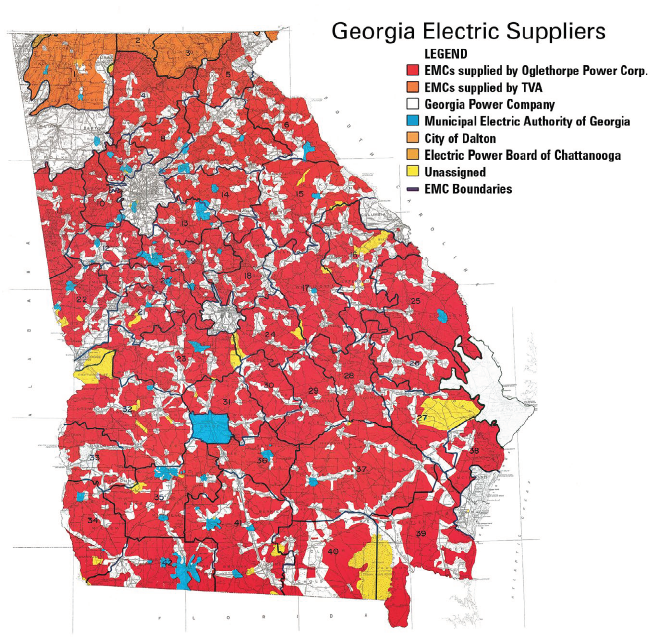
There are 94 electric utilities in the state of Georgia, each of which operates as a monopoly over its designated territory, which were defined in the 1973 Territorial Service Act. In addition to Georgia Power, there are 41 electric membership cooperatives—sometimes called electric membership corporations, EMCs, or co-ops—and 52 municipal electric utilities—sometimes called “electric cities,” or “munis”—which are owned and operated by a city or county government.
The Georgia Public Service Commission has limited regulatory powers when it comes to EMCs and munis. They oversee territorial disputes and transfers, loan applications, and rate tariff filings. All other functions are overseen by an elected Board of Directors, for EMCs, or an elected city council or county commission, for munis.
Because EMCs are cooperatives, which are “member owned,” customer-members have a role to play in influencing the decisions of the EMC through its elected board. Learn more here.
Similarly, because munis are electricity providers owned by a local government, customer-residents should expect fair service, affordable bills, and a certain level of input in their utility’s actions. Learn more here.
Georgia Energy Map
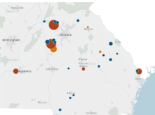
This map allows users to view the following: Power plants (by fuel and by capacity); Methane gas pipelines; Transmission lines; State legislative districts; Electric utility service territory; Energy burden (by census tract and by county); Demographic data. Data dictionary here. Access the map here.
Disclaimer: This map shows various data layers related to the energy environment in Georgia. The data primarily come from federal agency sources including Department of Energy, Energy Information Administration, and Census Bureau. This map and data is presented as is and for informational purposes only. This map is not an official source of this information. The owner of this map assumes no responsibility for the accuracy, timeliness, or completeness of the information contained herein.
Understanding high power bills
Why is my bill so high?
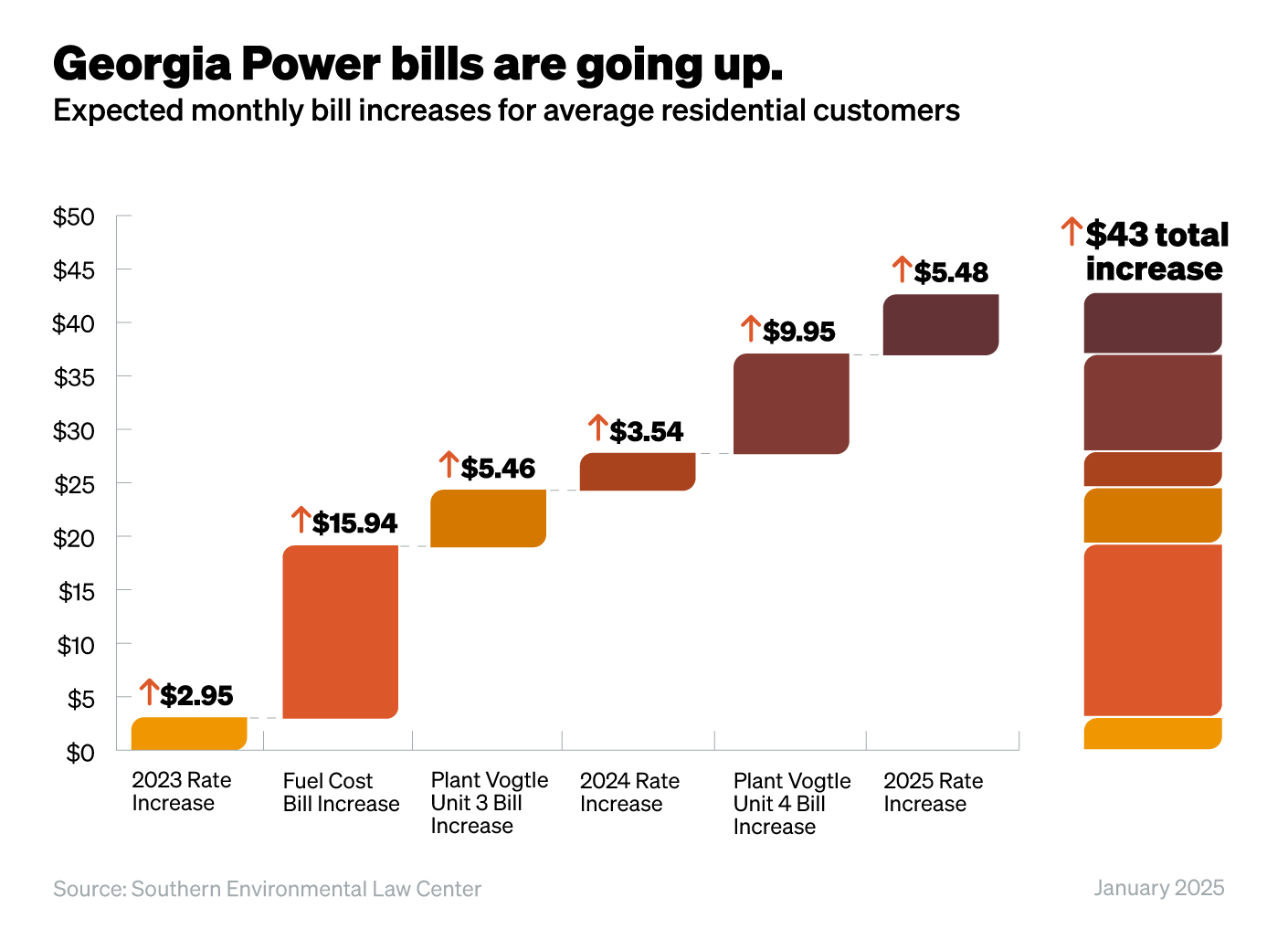
The Georgia Public Service Commission has approved seven increases to Georgia Power customers’ bills since 2023 (since the company’s last Rate Case which ended in December 2022).
There are many reasons for the increases, including passing onto customers the costs of coal and methane gas (a fossil fuel with a steep and often unstable pricetag) and the steep bills to fund the Plant Vogtle nuclear generating units, which were exorbitantly over budget.
Resources for understanding your bill
Southface’s “Electric Bills Decoded” blog series provides detailed information about Georgia Power bills.
Georgia Power’s “Understanding Your Bill” webpage. In particular look for the red button under the heading, “How do I read my bill?”
Energy & Policy Institute’s Utility Profit Tracker.
Resources for income-qualified customers
Community action agencies are local agencies that provide numerous services for Georgians experiencing poverty. Find your local community action agency here. Two programs focused in particular on energy bill relief are:
- the Low Income Home Energy Assistance Program (LIHEAP)
- and the Weatherization Assistance Program (WAP).
The above links will bring you to general information about the programs from the Georgia Environmental Finance Authority (GEFA), but note that community action agencies administer the programs directly to local communities. Be sure to find your own community action agency.
Georgia Power offers a few options for customers that meet certain income qualification requirements:
- Income-Qualified Discount – customers with a combined household income of 200% or less of U.S. federal poverty guidelines may qualify for a $33.50/month discount
- Energy Assistance for Savings & Efficiency (EASE) – free energy efficiency improvements for households with incomes 200% or less of the U.S. federal poverty guidelines
- HopeWorks – free home improvements for income-qualified seniors who own their homes
- Project SHARE – a program of the Salvation Army that can provide utility bill assistance to Georgians. Learn how to apply in your area here.
Additional resources to help customers save money by using less energy
- Home Energy Rebates – launched state-wide March 31, 2025; Georgians can receive money-saving rebates on the purchase and installation of electric appliances, insulation, air sealing, HVAC, and other energy efficiency measures
- Georgia Power’s Home Energy Improvement Program – rebates on eligible energy-saving improvements that you make to your home
Contact
For questions or to report possible bugs, errors, or technical difficulties, please contact Bailey Shea at [email protected].