Industrial chemical pollution in our water
Our communities deserve clean water that is free from industrial chemicals that harm our health, our families’ health and the health of our rivers and waterways. The number of chemicals created and in use by industry—even if not proven to be safe—that wind up polluting our water and communities has grown dramatically in recent decades. Such contaminants include 1,4 dioxane, and a family of thousands of synthetic or manufactured chemical compounds (including GenX) called per- and polyfluoroalkyl substances that are known as PFAS.
PFAS are “forever chemicals” that persist in water, soil, and the human body, and are linked to serious health risks. PFAS and 1,4-dioxane are not removed by conventional water treatment, making it critical to stop industrial water pollution at its source.
Stopping chemical water pollution
EPA and state agencies have the authority now to stop industrial pollution–including PFAS pollution–at its source before it gets into drinking water resources or waters where we fish and swim. But, too often, agencies do not require disclosure and enforce pollution controls for toxic PFAS and 1,4-dioxane. As a result, these agencies allow industry to conduct dangerous experiments every day on our families and communities by discharging undisclosed and potentially toxic chemicals into our drinking water, rivers, and lakes.
While scientific studies tie these industrial contaminants to health problems in people, their presence is often not disclosed by industry. In the United States, the Clean Water Act requires industry to disclose what pollutants it is putting into our drinking water sources. If industry does not tell permitting agencies and the public about the chemicals in its discharge, any release of industrial chemicals is illegal.
Families and communities everywhere deserve to know that the streams, rivers, and lakes they swim in, fish from, and rely on for drinking water are safe from toxic industrial chemicals.
Kelly Moser, Senior Attorney and Water Program Leader
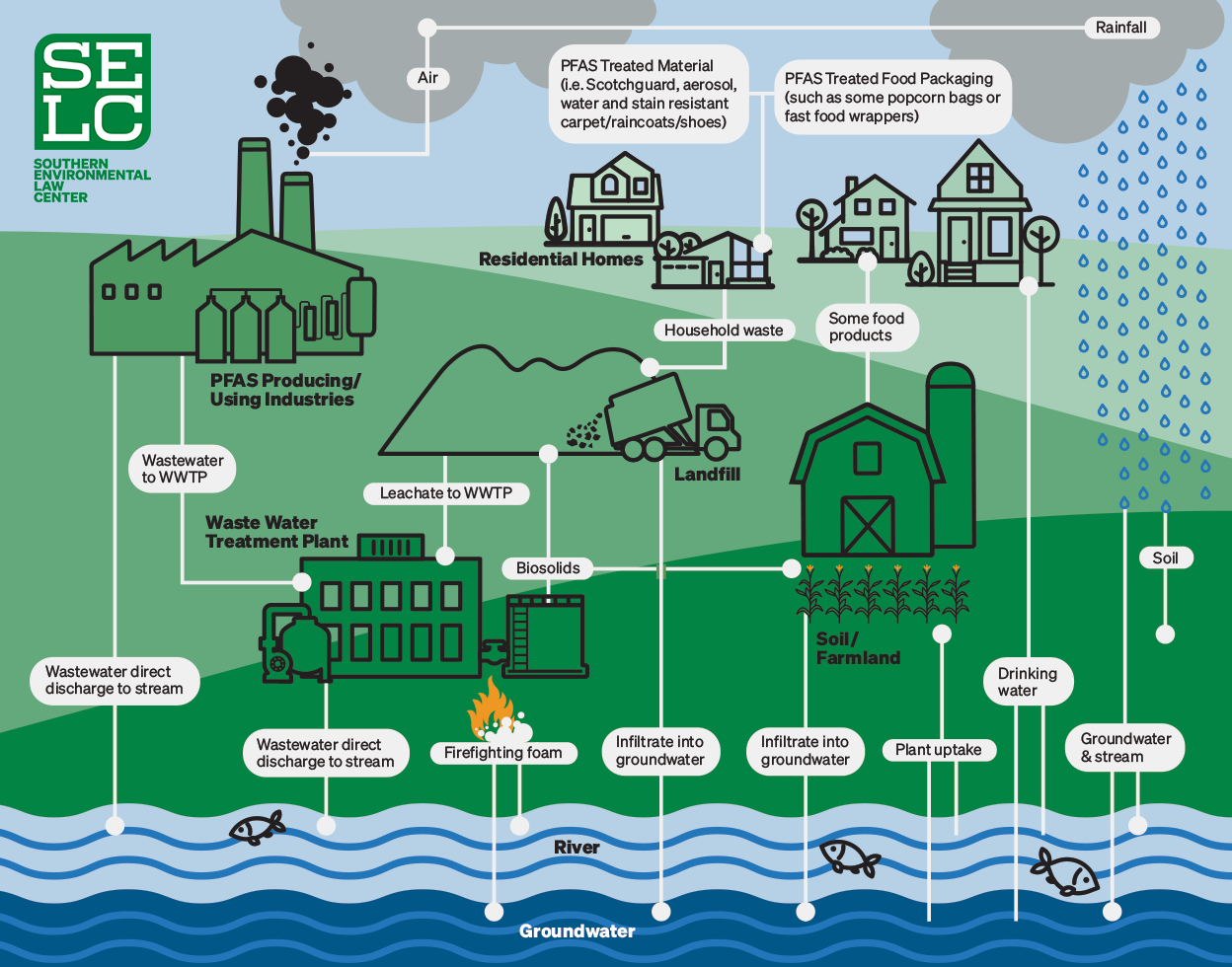
PFAS Cycle
PFAS are a class of thousands of manufactured chemicals that have been used in products and manufacturing processes since the 1940s. Due to their extensive use, including in food packaging, waterproof and stain-resistant coatings, and personal care products, PFAS are now present in our water, soil, air, and food. Some of the most acute PFAS pollution issues come from facilities that manufacture PFAS or use PFAS in industrial processes—such as the Chemours plant in North Carolina—and airports and military bases where PFAS-containing firefighting foam has been sprayed.
PFAS chemical water pollution & harm
Following a lawsuit against the Chemours Company for its years of GenX and other PFAS pollution in eastern North Carolina, SELC and our client, Cape Fear River Watch, continue to enforce the terms of a resulting consent order with the N.C. Department of Environmental Quality and Chemours to stop the PFAS pollution at its source and ensure the Cape Fear River is safe for downstream communities. The river is the drinking water source for Wilmington, N.C., and Pender and Brunswick Counties downstream. GenX and other PFAS were found in their treated drinking water at high levels.
Even though many of these industrial chemicals are dangerous individually, the bigger threat is that communities are never exposed to just one, but often have repeated exposure to multiple toxic pollutants. Landfills, hazardous waste sites, and other industrial facilities often affect the same communities. Far too often, they are concentrated in communities of color and low-income communities.
Industrial polluter accountability now
Failing to hold industrial polluters accountable means that downstream communities are forced to spend millions of dollars testing, identifying, and filtering out avoidable pollution from upstream industries. Communities downstream should not have to suffer the health consequences of avoidable pollution from upstream industries.
Industrial pollution must be stopped at its source so the polluter bears the burden and cost of it, not the families and communities nearby and downstream. Our litigation against Chemours and our advocacy were reflected in EPA’s National Pollutant Discharge Elimination System (NPDES) guidance to states in December 2022. The guidance directs states to enforce the Clean Water Act to stop PFAS pollution at its source and hold polluters accountable.
We are holding industrial polluters to account and urging state agencies across our region to ensure that permits under the Clean Water Act protect our water from PFAS and other industrial chemicals.