

South Carolina gas plant plans finally surface
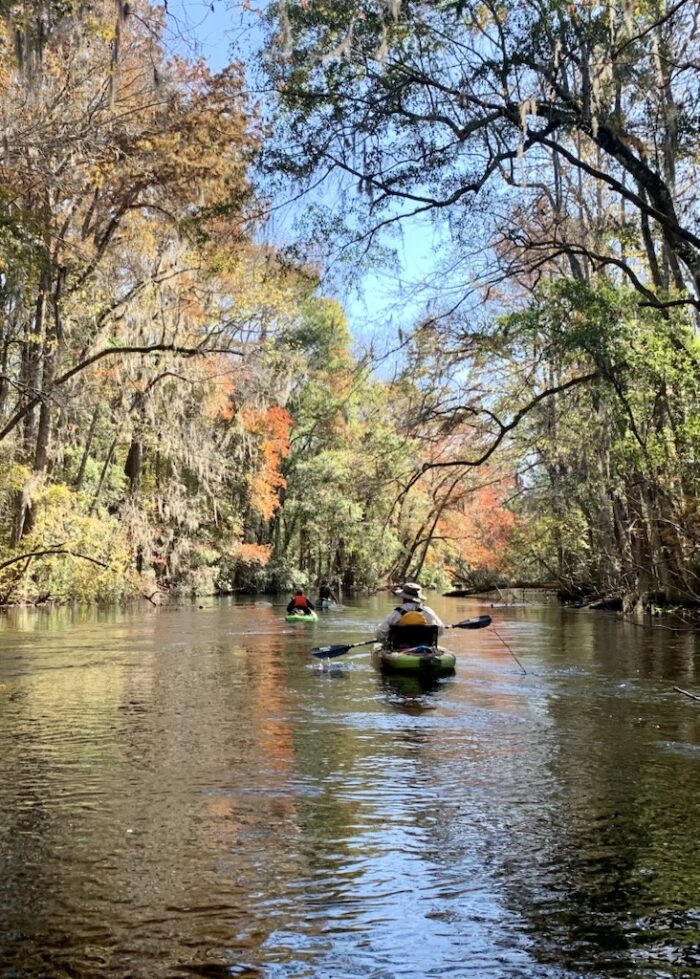
In October, a private pipeline company began informing landowners in Georgia and South Carolina that it’s eyeing their property for construction of a pipeline that would serve a proposed methane gas plant in Canadys, South Carolina. With the power of “eminent domain,” pipeline owner Kinder Morgan can force landowners to sell their property to make way for the project, whether the property owners want to or not.
For years, environmental groups have opposed Santee Cooper and Dominion Energy South Carolina’s plans to build one of the largest methane gas plants in the country on the banks of the Edisto River. Residents and natural resources in this area have already suffered from coal plant pollution for 50 years.
The proposed pipeline would serve the proposed gas plant. While the utilities claim this is necessary to keep up with rapid growth in South Carolina, SELC disagrees.
A better mix of renewable energy, battery storage, and energy efficiency programs would save more money for customers, reduce impacts to the environment, and protect communities from pollution.
And concerns extend beyond the project itself. Environmental groups, community members, and lawmakers have expressed concerns about the lack of transparency and opportunities for public input throughout the process.
This is already on track to be one of the most expensive gas fired power plants in history, and the health and environmental impacts will reach millions.
Eddy Moore, Southern Alliance for Clean Energy
No one voted for data centers and dirty air.
To make things worse, utilities championed the controversial Energy Security Act, which was passed by the South Carolina legislature in 2025, fast-tracking environmental permitting for energy projects and making it easier for utilities to raise rates for customers every year.
Many questions, few answers
Although the project was first mentioned in public filings and hearings at the Public Service Commission in 2023 – and included as part of Dominion’s long-term resource plan in 2023 and in Santee Cooper’s long-term resource plan in February 2024 – very few specific details about the project have been disclosed to the public. But more information has started to trickle out this year.
“We’ve been asking questions for years at the Public Service Commission and through public information requests, but we didn’t get answers about important details, like the plant’s specific cost, design, or the utilities’ plans to get gas supply to serve it,” said Kate Mixson, a senior attorney at SELC who focuses on energy work. “We know that gas power plants are expensive, polluting, unreliable in cold weather, and put customers at risk of volatile fuel prices, so of course we were concerned.”
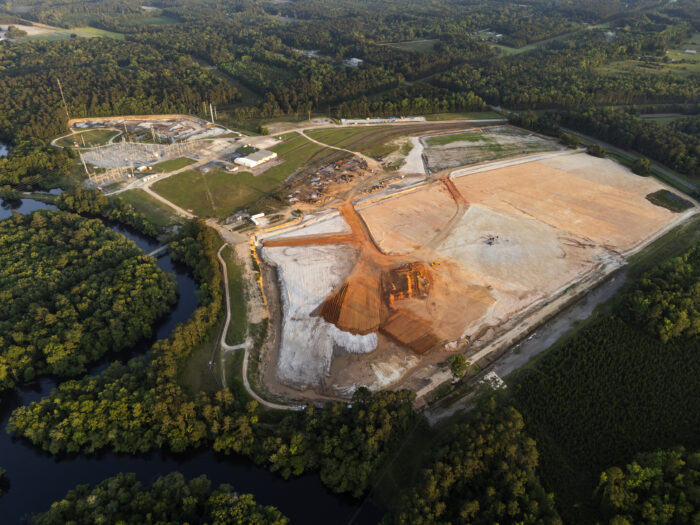
In 2024, rumors circulated that plans for the pipeline needed to service the plant existed, yet the public didn’t see them for another year. When SELC sent its first request for information about the new pipeline using the Freedom of Information Act, or “FOIA,” the response was that SELC already received any existing information during the long-term resource plan process.
Other entities, including the Post & Courier newspaper, sent requests for information and were told that that information included “trade secrets” and would therefore not be shared.
Eddy Moore, Decarbonization Director at Southern Alliance for Clean Energy, has been following the proposed project for years.
“This is already on track to be one of the most expensive gas fired power plants in history, and the health and environmental impacts will reach millions,” said Moore.
Information trickles out
In August, about 70 Colleton County residents and concerned citizens headed to the back room at Duke’s BBQ to hear from a coalition of environmental groups who shared information about the proposed plant and pipeline. It was standing room only and clear that residents were eager for more information.
While there weren’t many details available about the project at the time, Robby Maynor, SELC Climate Campaign Associate, presented information to the attendees about the proposed plant along with other partners like the Sierra Club, Conservation Voters of South Carolina, and the Coastal Conservation League.
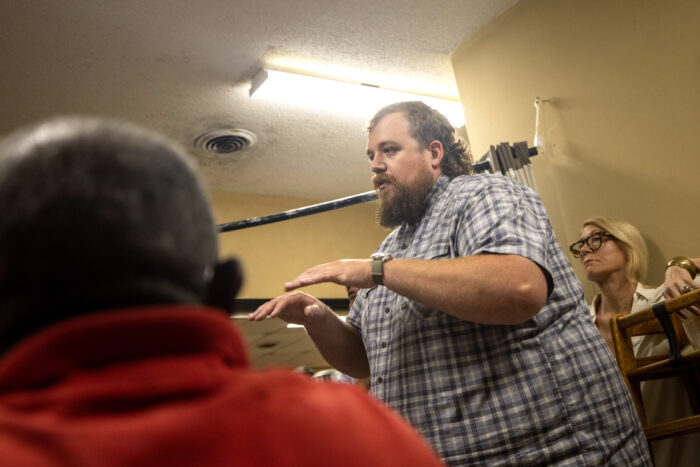
During the Q&A portion of the meeting, County Councilman Steven Murdaugh claimed that the county was behind the project 100 percent as it would bring economic benefits. He then shared the map of the pipeline that would serve the gas plant.
“Utilities have been talking about this power plant and the pipeline needed to serve it for years. Yet nobody has been communicating with the people who would have to live with the pollution from the plant, or the landowners who would have to give up their land for the pipeline,” said Maynor. “The fact that Kinder Morgan was sharing information about the pipeline route and it hadn’t been shared with impacted landowners is stunning.”
More information was revealed at Santee Cooper’s most recent board meeting on October 24. While Santee Cooper president Jimmy Staton told the state legislature in August 2024 that the project would cost roughly $2.5 billion in total, its cost has apparently doubled since then to $5 billion. The utility also revealed that they and Dominion planned to seek Public Service Commission approval for the plant in mid-December.
Environment and human health at risk
The pipeline would run through the upper portion of the Ashepoo, Combahee, and Edisto (ACE) Basin, threatening existing wetlands and water resources, wildlife habitat, and outdoor recreation opportunities. New infrastructure could mean more industrial construction along the pipeline route, bringing even more pollution to the surrounding areas. In fact, project proponents have made clear that this pipeline would lead to industrialization in rural Hampton and Colleton Counties, which could transform the rural landscape and way of life in this region.
One of the main local partners educating the community about this project is Hugo Krispyn, the Edisto Riverkeeper. Having stewarded the rivershed for many years, he’s not thrilled about the idea of a gas plant coming to the Edisto River after working for years to get the coal plant formerly at this site cleaned up.
“For 50 years, the community in Canadys was subject to an ongoing precipitation of coal ash, and there are ongoing health consequences from that. With that as the preamble to build a 2,200 MW plant there and resume the assault on people’s health and safety from particulates that result from the combustion from natural gas, what does that say to them – the ones breathing that pollution?” said Krispyn.
Without any information from the utilities as to how bad pollution from the plant would be for surrounding communities, environmental groups had to find out for themselves.
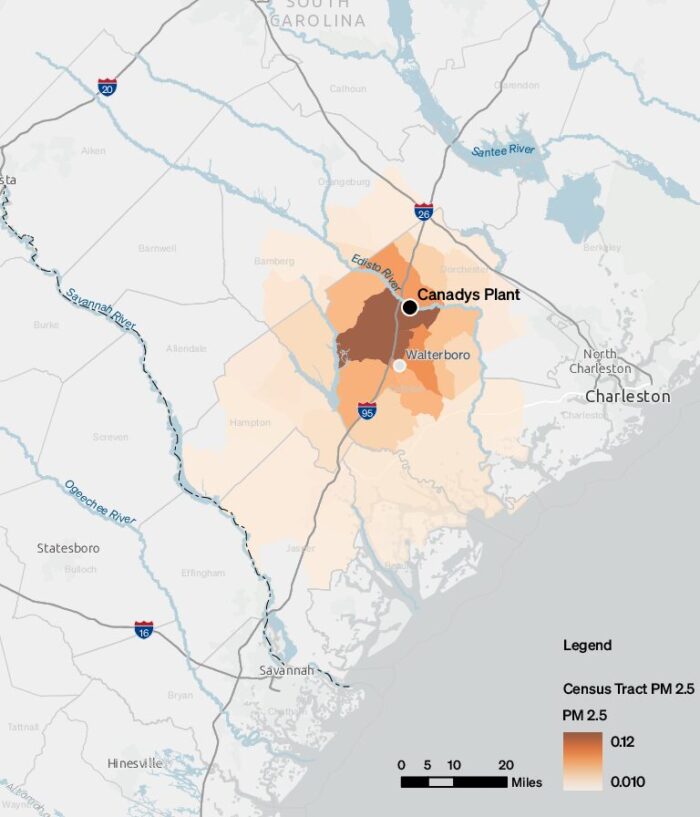
In October, SELC released a report by the Harvard Data Science Initiative that reveals projected air pollution from the plant and analyzes the health impacts and related costs of air pollution.
According to the report, every year the Canadys gas plant would emit at least 164.3 tons of particulate matter pollution or “PM2.5,” a harmful form of air pollution that is unsafe at any level of exposure. Particulate matter is a byproduct of the combustion of fossil fuels, and “2.5” refers to its small size of 2.5 micrometers that allows it to penetrate deep into the lungs and enter the bloodstream.
Even low levels of PM2.5 exposure can increase the risk of hospitalization due to heart attack, pneumonia, cardiovascular issues, or, in some cases, stroke or cancer.
Emissions modeling revealed that more than two million people in South Carolina, Georgia, and Florida would be impacted by additional PM2.5 exposure from the gas plant, and a disproportionate number of Black residents and less wealthy residents would face the most severe pollution.
This pollution could result in up to $28 million in healthcare related costs annually due to increased disease burden on impacted communities, increasing to $36 million annually by 2040 due to inflation.
Read more about the report here.
“It’s unfortunate that we had to be the ones to model this pollution rather than utilities sharing the potential health risks,” said Mixson. “Hopefully, this will equip people with the information they need to voice any concerns about the project now. We just have to hope the utilities will listen.”
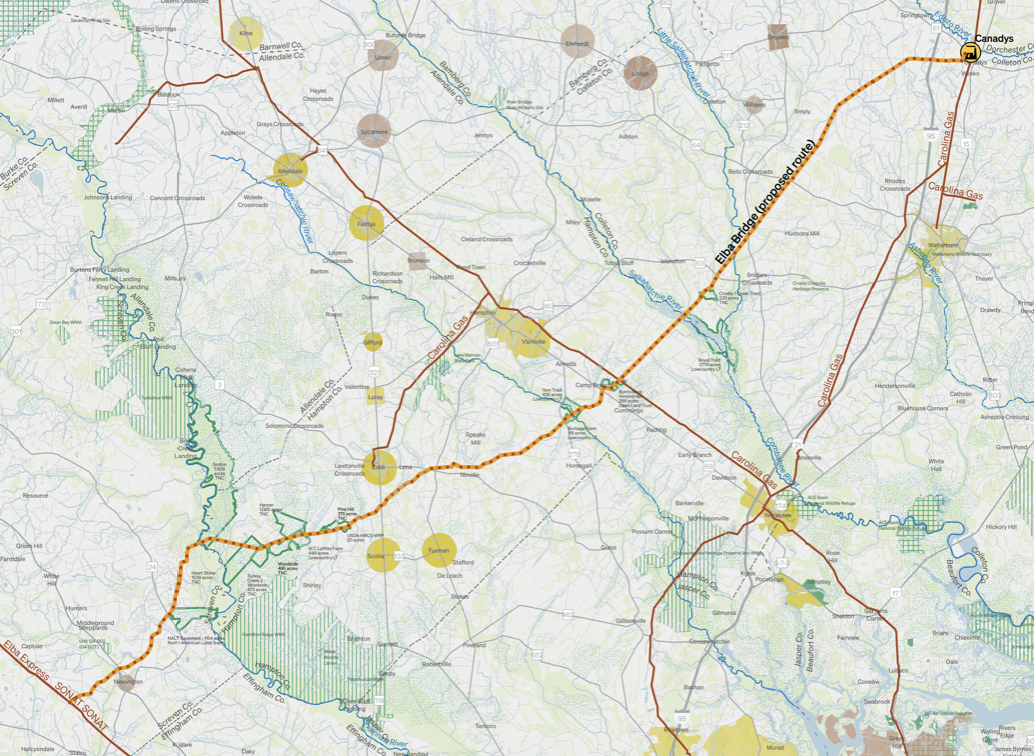
Proposed route of the Elba Bridge Pipeline
The fight is on
While information is slowly trickling from energy corporations to the public – and environmental groups taking on the responsibility of informing the public – there’s still a lot that the public does not know about this project. While it’s been proposed, it’s not decided or approved. The process is just starting – landowners are engaging with Kinder Morgan about the pipeline route, nonprofits are sharing information they have about the proposal, and Santee Cooper, Dominion Energy, and Kinder Morgan still have to apply for needed permits and approvals.
In December, Santee Cooper and Dominion Energy applied for approval for the gas plant at the South Carolina Public Service Commission. The application kicks off a months-long process during which the Public Service Commission will review the plans for the 2,200-megawatt methane gas plant.
The Southern Environmental Law Center, on behalf of the Coastal Conservation League and the Southern Alliance for Clean Energy, filed to participate in the docket as intervenors.
“We’ll be engaged every step of the way,” said Maynor.