
The small North Carolina town with big clean energy plans
Updated April 21, 2026. The latest update includes the recent investment Enfield secured to fund a landmark geothermal system and keep their vision of a clean energy future alive.
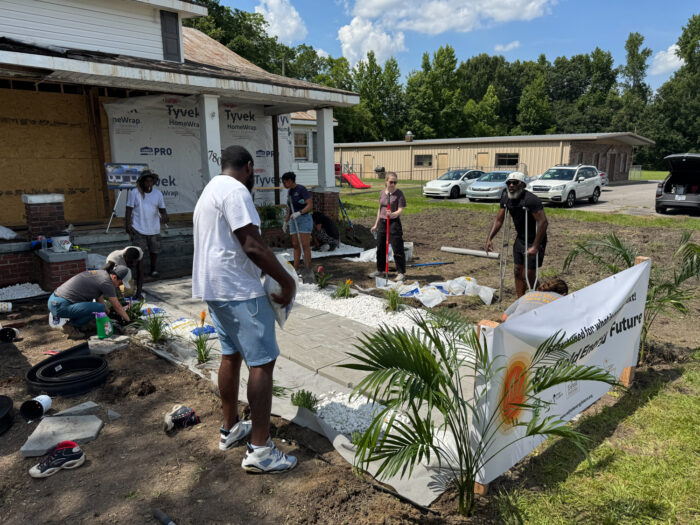
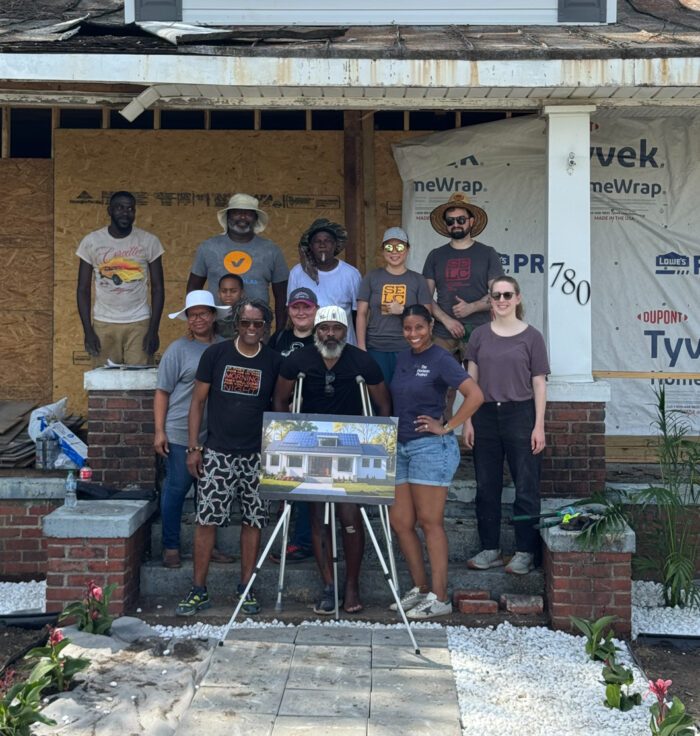
On a sweltering Saturday in June, volunteers gathered outside of a white house near the southern edge of Enfield, North Carolina.
“Is it hot?” grinned Enfield mayor Mondale Robinson, pausing to chat in a small patch of shade. “Is it? I didn’t even notice.”
A rendering propped on the front porch showed the vision for the property, including a flower-lined walkway and rooftop solar panels.
Purchased a few months ago by Mayor Robinson, the house is set to become Enfield’s “weatherization hub,” where residents can receive hands-on energy efficiency trainings, use the space’s strong Internet connection to work remotely, and track the building’s battery storage in real time.
I wanted to show people what it means to power a building by the sun.
Mondale Robinson, Enfield Mayor
The plan today was simple but meaningful: plant flowers and lay tiles for the walkway leading to the entrance.
As volunteers sipped water bottles and got to work, the intense heat and sunlight underscored the potential for clean energy in Enfield, which sees more than 260 sunny days per year. The weatherization hub is part of a broader vision for the town that includes a 34-acre solar farm and a new energy substation to replace the town’s aging infrastructure.
The goal, Robinson explained, is to make Enfield a green energy hub in the region – lowering people’s energy bills, increasing the town’s resilience, and spurring job opportunities.
A clean energy future within reach
To understand the vision for Enfield’s clean energy future, understanding its history is key.
Where the future weatherization hub now sits, Robinson said, is the last address within town limits on Highway 301. In the first half of the 20th century, this road carried travelers heading south to Florida, fueling local businesses: a few hotels, a bus station, Ford and Chevy dealerships.
When I-95 was built in the 1950s, things changed.
“No one thought that we needed to make sure the traffic from 95 still found its way to support industries in Enfield,” said Robinson. He connects that decision to the larger history of America’s disinvestment in majority-Black communities like Enfield.
“America has a long history of un-developing – not under-developing – Black America. Highway 95 is part of that un-developing,” said Robinson, adding that Enfield’s high poverty rates today are as unintentional “as the sky is green.”
Today, Enfield residents not only experience one of the highest rates of poverty in North Carolina but also bear some of the state’s highest energy bills. Homes with older, substandard insulation and cooling systems and the fact that the town buys energy third-hand have contributed to that energy burden.
We’re not just poor, we’re energy-poor.
Mondale Robinson, Enfield Mayor
The proposed solar farm, weatherization hub, and grid upgrades aim to change that. For a community of just a few thousand, this solar farm could generate enough energy to meet almost all the town’s demand. By producing its own energy instead of purchasing it at inflated rates, Enfield could significantly reduce bills.
Upgrading the town’s substation – a fragile, outdated system responsible for outage rates up to 100 times the state average – is another key step.
At the same time, the weatherization hub would offer training programs to help residents lower their energy bills using tools like weather sealing and insulation.
What’s standing in the way?
Robinson laughed. “The federal government.”
Federal roadblocks
Earlier this year, Enfield had hopes of receiving a grant from the Department of Energy’s Office of Clean Energy Demonstrations – a program designed specifically to support clean energy and resilience initiatives in rural towns with fewer than 10,000 residents.
“The grant would have funded what Enfield is trying to do – rebuild the grid and build a relatively small solar-plus-storage facility to meet the town’s energy needs,” explained Nick Jimenez, senior attorney with the Southern Environmental Law Center, who has been working with town leaders and climate action partners to further solar solutions in Enfield.
But the momentum came to a halt.
“A few weeks ago, a town administrator forwarded me an email from the Department of Energy. The grant was terminated,” Jimenez said.
As one of the least-cost sources of power, solar is a vital tool to meet energy demand, bolster resilience, and create local jobs. Yet recent federal actions – including the removal of tax credits in the new budget bill – have made it harder for small municipalities, utilities, and households to access solar technology.
Still, Enfield is far from giving up. Town leaders are now exploring alternative routes, from state-level funding to private investments, and are working with congressional representatives to keep the vision alive.
“They’re completely committed to making it happen, whatever it takes,” said Jimenez.
Making it happen
A few setbacks last year didn’t stop Enfield from fighting for clean energy in their community. The Enfield Energy Futures coalition recently announced their boldest project yet. A first-of-its-kind municipal geothermal network is one step closer to becoming a reality for the town.
“For generations, communities like ours were denied investment, denied opportunity, and denied the basic dignity of being seen as worthy of the same future as everyone else,” shared Robinson. “But our people have never stopped believing, never stopped building, and never stopped fighting for what we deserve. This BuildUS grant is not just funding—it is a declaration that even a small rural Black town can lead the nation toward a more just and sustainable future.”
Enfield secured an investment of $278,633 that will fund engineering, community outreach, and development for the landmark geothermal system. Expected to break ground in April, the geothermal system could serve as a model for the more than two dozen municipal utilities across Eastern North Carolina—many that have historically faced disinvestment and unreliable power grids.
“The Enfield community’s commitment to their vision for a clean energy future is starting to be realized” said Nick Jimenez, a senior attorney. “This grant will allow the coalition to provide residents an affordable, reliable energy solution and bring costs down.”
So how does it work? Networked geothermal systems use an underground “loop” to allow homes and buildings equipped with ground-source heat pumps to share thermal energy for heating and cooling.
“This first-of-its-kind geothermal network brings us one step closer to energy independence, one step closer to equity, and one step closer to breaking cycles that were designed to hold communities like Enfield back,” said Mayor Robinson. “What we are doing here is bigger than infrastructure—it is legacy work. It is justice work. And I believe with all my heart that what rises in Enfield today can help transform communities across the South for generations to come.”