Words and pictures by Phuong Tran
As our climate continues to warm, more and more evidence reinforces the importance of trees and their shade in ensuring everyone can weather the hotter summer days and nights ahead.
Across the South, we see communities suffering from dangerously hot summer days. This is the combined result of extreme heat worsened by climate change and the urban heat island effect, where the materials like concrete and asphalt used in parking lots, buildings, and roads hold and give off heat more than natural ground cover like bodies of water, trees, and other plants. This means, on the same day, a city center will often be notably warmer than nearby suburban or rural areas.
One place this is playing out is the Southside of Richmond, a historically Black area named for its place relative to the James River. Years of weak zoning and disinvestment created a landscape with fewer trees and green spaces. Life expectancy for Southside residents is up to 20 years shorter than the rest of the city, and many neighborhoods don’t meet the city’s goal of living within 10 minutes of a park or playground. The urban heat island effect can mean that on an 85-degree day, parts of the Southside experience heat over 100 degrees. Even if you have working air conditioning in your home, the electricity bills required to keep safe and cool during this type of heat wave are often too expensive for many to afford.
Richmonders Sheri Shannon and Amy Wentz, a long-time resident of Southside, were disheartened to learn how far the Southside fell behind in almost all categories as they were taking part in the city’s master planning process. The two friends met for lunch one day to talk about their concern and decided they needed to do something about it.
“We really wanted to push the city to focus on the Southside, not only increasing and expanding green spaces, but also funding connectivity, housing, food security — all of these things are needed to give people their basic needs,” said Shannon.
We were really two volunteers who were just trying to do some good.
Sheri Shannon, Southside resident
Their partnership, advocacy, and conversations around the issue sparked the 2019 creation of Southside ReLeaf, whose mission is to help improve the life expectancy and quality of life for Southside residents by increasing green spaces, reducing pollution, and improving infrastructure. Plantings are a key activity as they help cool temperatures, lower energy costs, minimize flooding and improve air quality.
Since its founding, the group has planted and given away more than 1,000 trees, and fostered partnerships to plant and care for hundreds more across Southside. Their work has transformed neighborhood anchors like elementary schools and community centers.
Greening spaces through collaboration
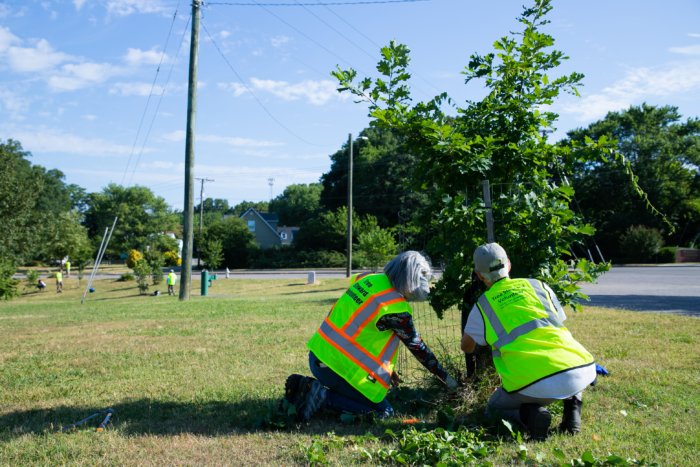
The environmental justice nonprofit has changed the landscape of the community through grassroots organizing, partnership building, public education, and advocacy.
Meeting people where they are, the group educates the community about the heat island effect, how their communities are disproportionately impacted, and the critical role urban forestry plays in countering extreme heat and improving people’s health. The results of their outreach include onboarding four of five new parks in Richmond — the first since the 1970s, hiring of the city’s first urban forester, and preservation of a community green space when it came under threat of demolition.
Shannon and Wentz also went door to door, passed out flyers, talked to neighbors about heat islands, and shared how green spaces can help.
“Their work kind of woke the Southside up,” said Rodney Gaines, a local tree steward and community organizer who participated in the group’s early listening sessions. “Once they engaged the community, everyone was on board and wanted to volunteer,” said Gaines. “For 25 to 30 years, there had been no trees in between the houses and the sidewalk. Then Southside ReLeaf came and planted more than 60 trees in my neighborhood. Once we finished, it was a feeling of gratification. You don’t see your neighbors other than in passing and this is something we all did together — and we’re still talking about it to this day, whenever we pass these trees.”
Planting trees, planting hopes
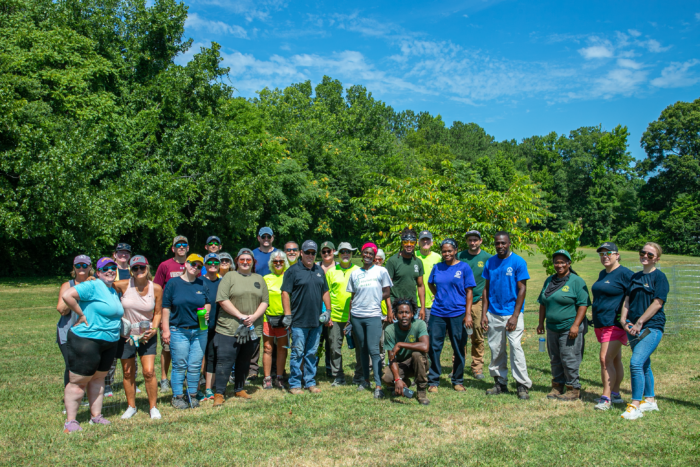
Last fall Shannon and Wentz returned to Blackwell Elementary School, where Southside ReLeaf held their first tree-planting event, with more than 40 volunteers. There were two little girls playing on the swing who asked Shannon what the volunteers were doing with the trees.
Shannon told them about Southside ReLeaf and pointed out the trees they had already planted there five years ago. “Wow! They’ve grown so much bigger,” said the girls. “Thank you.”
As Shannon recalled the story, she couldn’t help tearing up. “As I think about those two young girls and how they are our future, it gives me hope because I was able to teach them about our work and empower them,” she said. “We’ll only have a better tomorrow if we show up for each other and be in community with each other.”