

Overhyped data center growth is shaping our energy future
Come with SELC to data center alley.
There’s a subtle hum in the air across Northern Virginia.
It comes from a sprawling conglomerate of giant rectangular, windowless buildings. Many are visible from the streets, with a few tactfully concealed from neighborhood view. When they aren’t marked, the average person might not know what they’re looking at: data centers. A lot of them.
This is Data Center Alley, located in and around Ashburn, Virginia. It’s the main data center hub in a state that’s home to around 300 of the facilities.
Northern Virginia has roughly 35% of the world’s data centers.
Virginia may be the data center capital of the world, but it’s not the only hotspot. Similar facilities are popping up in Georgia, Tennessee, and other states across the South.
Data centers require massive amounts of energy to operate. Although some tech companies have made commitments to powering the facilities with renewable resources, many are instead relying on electricity produced from methane gas.
Methane has over 80 times the warming power of carbon dioxide for its first 20 years in the atmosphere. Utilities try to brand it as clean, “natural” gas, but methane is really a dangerous fossil fuel and super pollutant responsible for a third of the warming from greenhouse gases.
Data centers play an important role in how we use the internet, but it’s important to power them sustainably.
A groundbreaking new report commissioned by SELC shows that much of the projected data center demand is speculative — if not outright implausible.
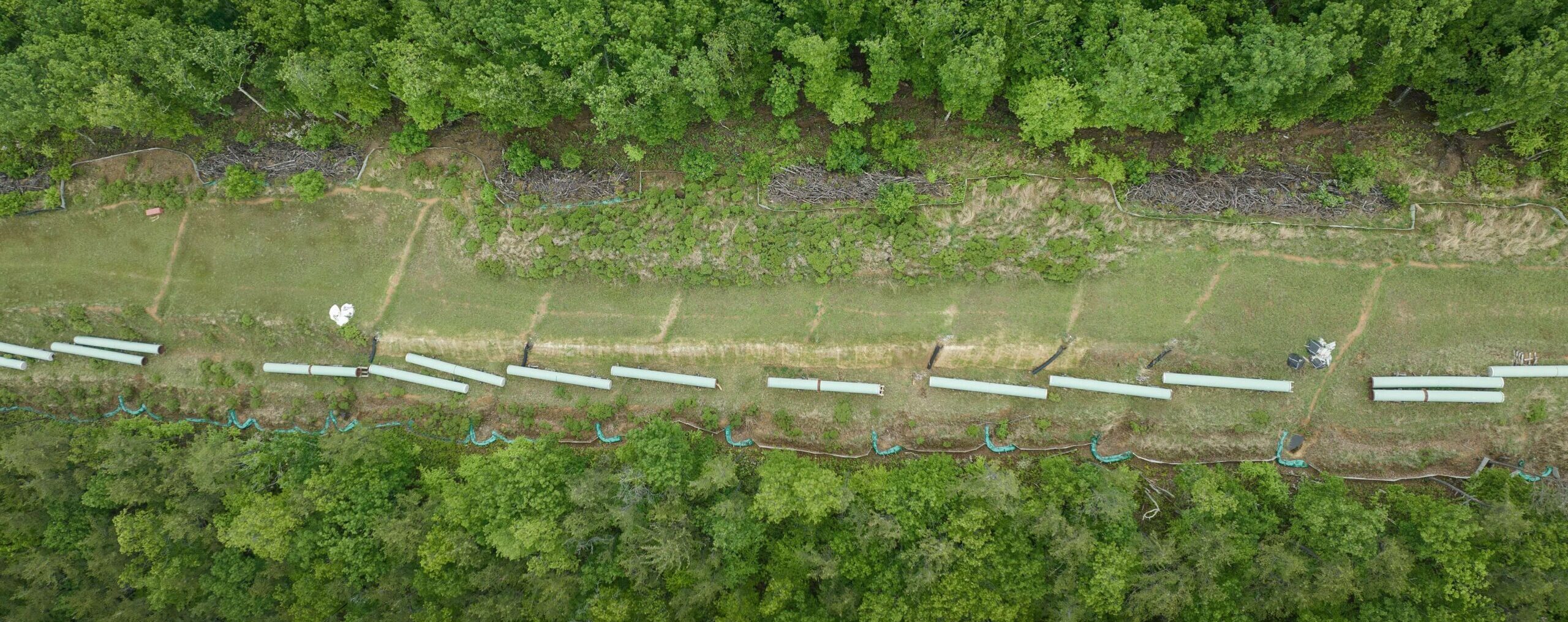
What’s the risk in that? Monopoly utilities build new gas plants, and gas companies build pipelines and wells to meet demand that isn’t really there, leaving Southern communities to pay the price.
What are data centers?
Since the early 2000s, data centers have been used to house computing machines and hardware for storing, processing, and distributing digital information.
- The U.S. is home to the most data centers in the world, with thousands of data center facilities across the country. Many are expanding across the South.
- These facilities are used for online activities varying from things like file storage and processing online transactions.
- Generative artificial intelligence (AI) computing has become the fastest-growing segment of data center power demand.
- The energy impact of AI is significant: a single ChatGPT query requires almost 10 times as much energy as a single Google search.
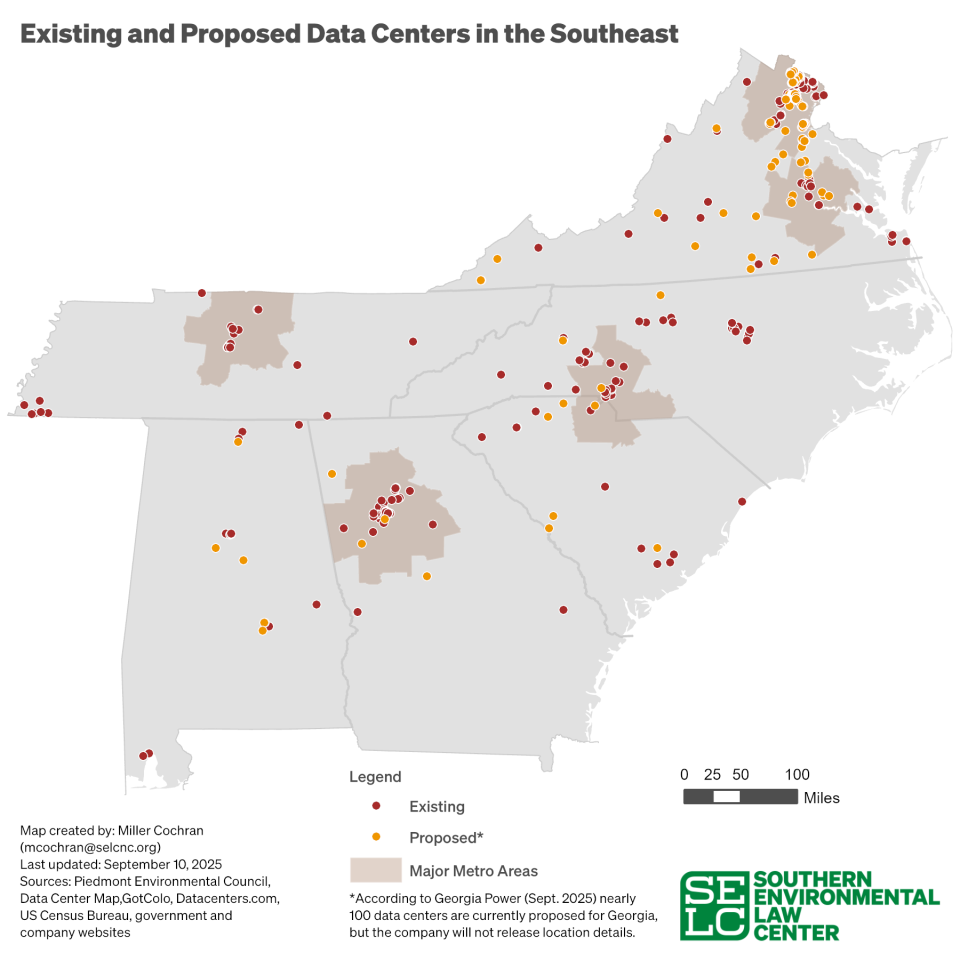

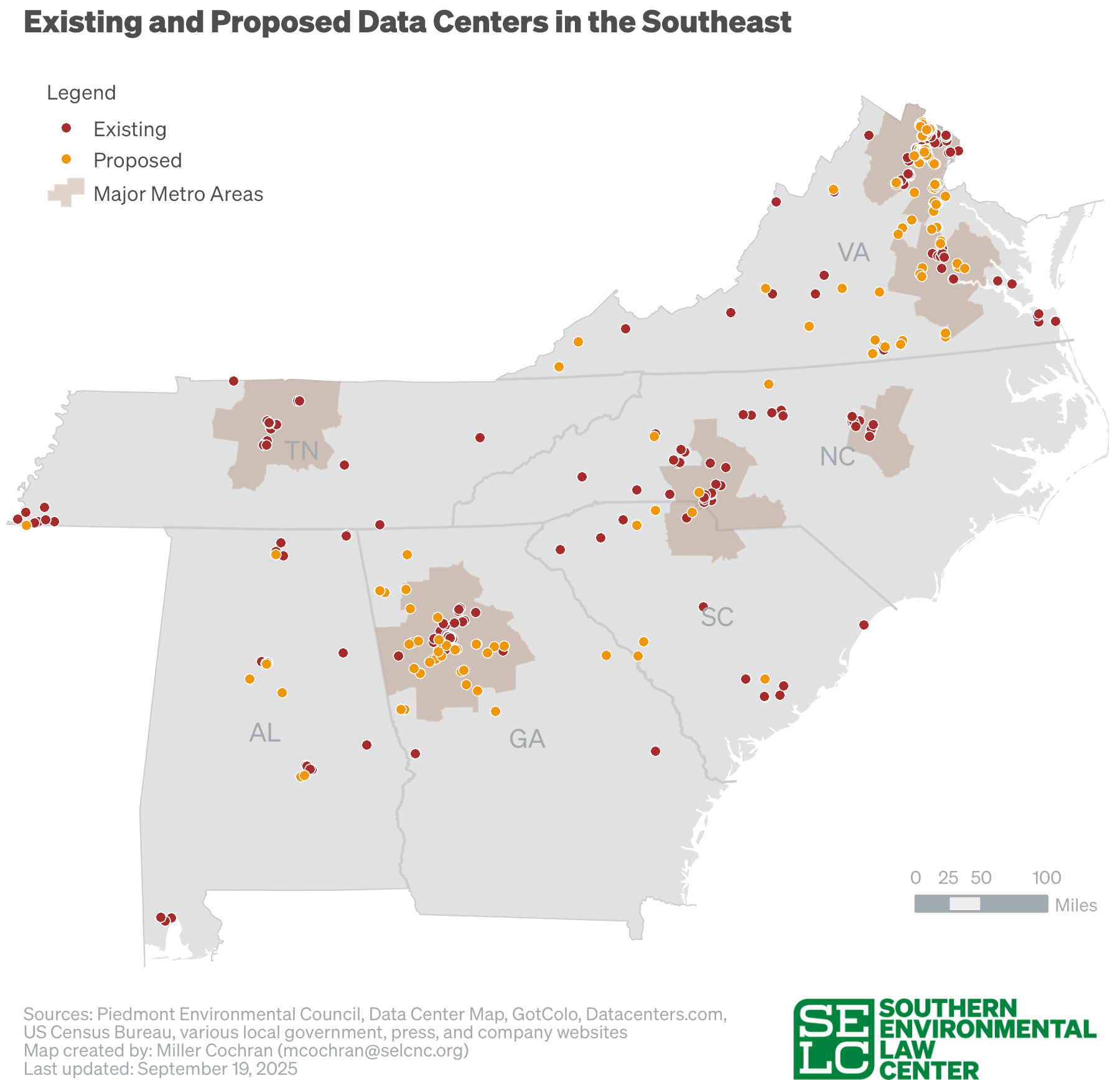
Existing and Proposed Data Centers in the Southeast
Increasing power demands amid regulatory rollbacks
Electricity demand from data centers around the world is predicted to double by 2030, according to the International Energy Agency (IEA). AI is expected to be the primary driver behind the increase – the IEA predicts demand from AI-optimized data centers will quadruple in the next five years.
The Trump administration has been taking its own actions to promote the growth while reducing pollution protections:

- President Trump has a plan to invest at least $500 billion in data centers and AI over the next four years.
- In January, the Trump administration declared the U.S. was in a national energy emergency from inadequate energy supply. A few days later, President Trump signed an Executive Order establishing the U.S.’s commitment to becoming a national leader in AI.
- As the Trump administration promotes AI development, they’ve also been halting plans focused on cleaner, renewable resources – including solar and wind – that could help meet energy demands.
- The EPA has repealed rules that enforced coal plant pollution limits. Recently, the organization also proposed repealing updates to the Mercury and Air Toxics Rule and Carbon Pollution Standards – all of which will allow power plants to continue polluting our air.
- The EPA proposed to repeal the “endangerment finding,” which declared greenhouse gases as a danger to public health, forfeiting its legal authority to limit climate pollution.
We’re in the midst of a massive methane gas buildout, which Daniel Brookshire, SELC’s energy utility and policy analyst, says is coming as demand increases and utilities retire older coal plants in favor of new methane infrastructure.
Monopoly utilities in the South are rushing to build 43,000 megawatts of methane gas plants over the next 15 years.
“Just to put that in perspective, 1,000 megawatts is close to the size of just one nuclear power plant,” Brookshire said. “We’re talking about 40 of those.”
New analysis reveals implausible data center projections
A new report commissioned by SELC from London Economics International (LEI) shines a light on the upward bias prevalent in data center electricity demand estimates.
Chip supply shortage
The report reveals that projected data center energy demand through 2030, from just 77% of the U.S. market, would require 90% of the global chip supply. In other words, things aren’t adding up: the current demand projections for data centers are implausible to actually build.
“These findings underscore a critical and ongoing concern: inflated and speculative data center electricity demand forecasts in the Southeast are driving a dramatic and unnecessary overbuild of infrastructure that threatens to lock in fossil fuels, hike energy bills, and crowd out more reliable, cost-effective clean energy,” SELC Senior Attorney Megan Gibson said. “Such speculative infrastructure investment creates significant economic risks for individuals, who ultimately bear the financial burdens in higher utility bills and high costs of accelerating climate disasters.”
Repeated, redundant requests
Companies are submitting extra requests to build more centers because they know most of the proposals won’t get realized. When there are 5-10 times more requests than actual centers being built, it’s difficult for regulators to plan, manage cost concerns, and leave room for sustainable infrastructure.
It’s possible to construct data centers without such an intense strain on our energy resources. But too many companies rely on utilities that use the projected growth to justify costly, dangerous methane buildouts, stopping progress before it can even properly start.
Uncertainty and upward bias are inherent in data center electricity demand projections
A report by London Economics International (LEI) commissioned by SELC finds that electricity demand forecasts tied to U.S. data center growth are plagued by uncertainty and systemic overstatement. The report identifies compounding industry challenges and incentives that reflect a bias to overestimate growth in data center electricity demand. SELC finds this has serious implications for the Southeast.
What does this mean for the people of the South?
When data center demand is used to justify a massive methane gas buildout, Southern consumers will pay — with their wallets and their health.
Polluted communities
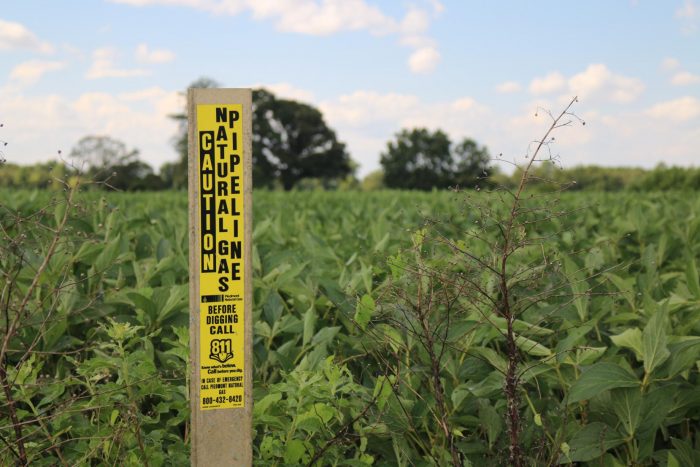
Brookshire says with this huge shift to methane gas, leaks at pipelines and fracking sites are inevitable.
“Methane escaping is really bad,” he said. “Even little leakage rates can sometimes offset any climate benefit that gas might have over coal.”
Here’s what we know about methane gas leaks:
- A study from John Hopkins University found that methane gas leakage from pipelines emits four times as much methane as current national estimates suggest.
- Methane gas power plants and compressor stations threaten surrounding communities — often communities of color who have already borne the brunt of harm from industrial facilities for decades — with dangerous air pollution. This includes pollutants like fine particulates and formaldehyde which are harmful even at very low levels.
- Along with lowering air quality for locals, gas leaks can impact people even across state borders and pipeline infrastructure can be dangerous beyond public health and are prone to explosions.
Unpredictable prices
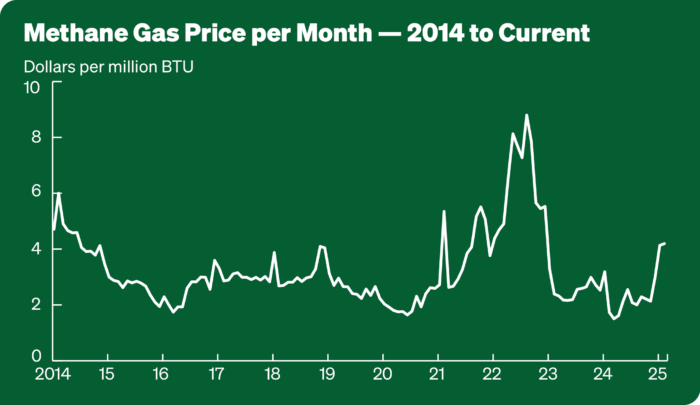
Methane comes with financial risks, too. Gas pricing, Brookshire says, is extremely volatile. As utilities profit from over-reliance on methane, prices increase because of a shortage of necessary infrastructure materials.
These utilities, they pass the full cost of all their fuel resources straight on to customers. There’s no risk in our region of utility shareholders or the company itself bearing the costs of the fuel.
Daniel Brookshire, Energy Utility and Policy Analyst
It doesn’t have to be like this
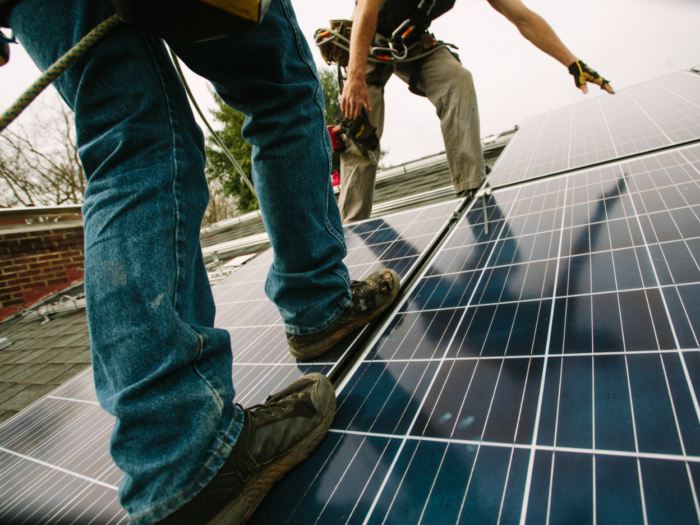
There are ways to take the strain off the growing energy demand from data centers. Some corporations are already realizing that we don’t need dirty methane to power our lives.
Renewable energy resources like solar and wind are strong alternatives to methane. They’re cost-effective – a new report from the International Renewable Energy Agency (IRENA) finds that 90% of renewable resources worldwide are cheaper than fossil fuels. They’re better for our communities and climate while also being predictable, so consumers don’t need to worry about volatile pricing shifts.
You can really store that renewable energy for when the sun isn’t shining and the wind isn’t blowing to use it.
Daniel Brookshire, Energy Utility and Policy Analyst
We’re already seeing change across our region:
- In Virginia, the nation’s largest offshore wind project is advancing with the intent of powering at least 660,000 homes when it’s complete.
- Silicon Ranch, a solar company based in Tennessee, is collaborating with the data center planning company Tract to develop greener hyperscale data center campuses.
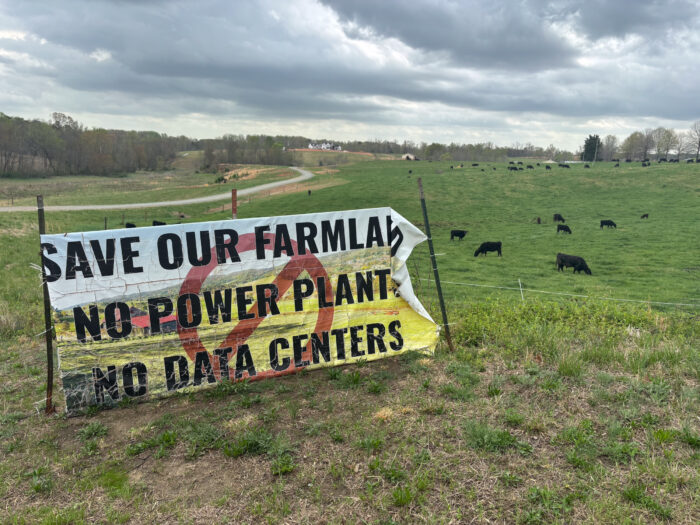
- Residents can take matters into their own hands, like the community of rural Pittsylvania County, Virginia, did when they were able to block an enormous data center complex and power plant.
The LEI report reveals how difficult it is to accurately predict how many data centers will come to fruition. But data centers are going to keep developing across the South – we still have a chance to ensure they’re being powered in sustainable ways.
Many of the largest data center companies have made strong commitments to power their systems with clean, renewable energy. As the impacts of climate change intensify and energy demands increase, it’s critical that we hold them, and our Southern utilities, to those standards.
Nobody voted for pipelines in their backyards, methane gas leaking into their neighborhoods, or regulated monopolies profiting at their expense. As data center growth surges and utilities prepare to expand, Southern communities get the short end of the stick.