

We’re suing to protect one of the most important conservation areas in the South from data centers
In the Lowcountry of South Carolina lies the ACE Basin, one of the Atlantic Coast’s largest areas of undeveloped wetlands and uplands ecosystems positioned around the Ashepoo, Combahee, and Edisto rivers. For nearly 40 years, this 1.7-million-acre watershed has been protected by large conservation easements, boasted untouched environmental resources, and maintained the rural character cherished by residents.
This legacy of conservation is under threat due to a new Colleton County ordinance that makes it easier for data centers to be built in rural areas.
There is no universe where this should be allowed anywhere near the ACE Basin.
Jennifer Singleton, Colleton County resident
That’s why SELC just filed a lawsuit to stop this zoning change, and the first data center project to take advantage of it—a proposed 859-acre, 1,000-megawatt complex that would be one of the largest in the country.
Help us stop data centers and dirty air. Donate today.
New data center development would degrade rural nature of the area
On behalf of two Colleton County residents, SELC filed a complaint this week over the recently passed zoning ordinance that creates a special exception for data centers and makes it easier for them to locate in rural areas of the county. The lawsuit argues that the county’s new ordinance violates state law, the county’s comprehensive plan, and the county’s zoning code.
“This zoning ordinance opens up a treasured and rural part of our state to industrial development and all the pollution and degradation that comes with it. Data centers don’t belong in the rural ACE Basin,” said Emily Wyche, SELC Senior Attorney. “Colleton County should be continuing the legacy of conservation in this area, not selling it to the highest bidder.”
Shortly after the zoning ordinance passed, the public learned that Eagle Rock Partners had filed an application to construct a massive data center campus in a rural part of Colleton County.
Data centers not only use large quantities of energy, but they can also:
- adversely impact water quality,
- contribute to noise and light pollution,
- and degrade the character of rural communities.
Residents, including those named in the lawsuit, say that the ACE Basin is the last place a data center should be built. These impacts would threaten the ACE Basin’s many threatened and endangered wildlife species, cultural and archaeological resources, and untouched swaths of land.
“I did my due diligence and specifically chose to move to an area that was zoned for rural agricultural use,” says resident Jennifer Singleton. “Now with Colleton County passing this ordinance, opening the door for this 9-building data center campus, this entire pristine and vulnerable area is under attack undermining decades of conservation.”
Colleton County residents strongly oppose massive data center proposal
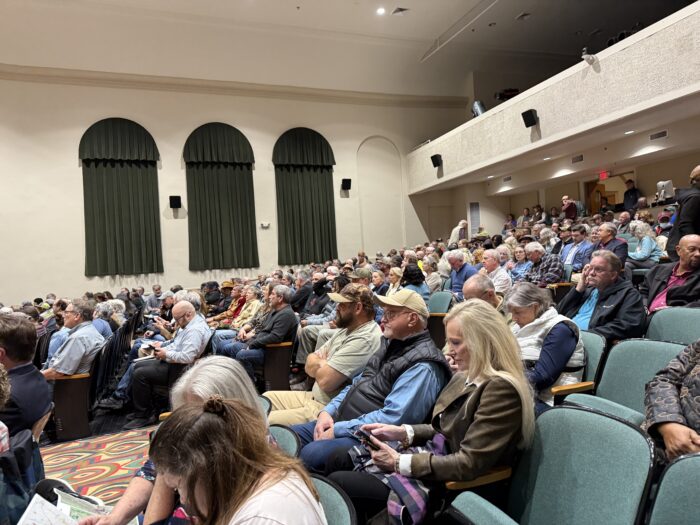
In December, the Colleton County Zoning Board of Appeals held a public meeting to discuss Eagle Rock Partners’ data center application.
Over 450 residents and many environmental nonprofits attended to raise concerns and oppose the proposal.
Speakers touched on:
- environmental impacts,
- low quality jobs,
- preservation of the area’s rural nature, and
- who will pay for the extra power needed to run the complex.
“As a lifelong Colleton County resident, I’m seriously concerned about the harm the data center construction would have on our rural community, local wildlife, and the environment,” says resident Miles Crosby. “We cannot allow this ordinance to threaten our star-filled night skies, natural quiet, and enjoyment of landscapes with light, water, and noise pollution.”
An online petition to stop the data center has over 7,000 signatures.
This is not the first time Eagle Rock Partners faced opposition to their data center proposals. In Twiggs County, Georgia, a group of local landowners sued the county for a rushed rezoning process and approval of another proposed Eagle Rock data center despite extreme local opposition to the project. In Jones County, Georgia, Eagle Rock recently cancelled a proposed data center in response to significant local push back.
In Colleton County, Ken Loeber, representative for Eagle Rock Partners, was the only speaker who voiced support for the proposal.
Considering the public outcry over the application, the Colleton County Zoning Board of Appeals said that Eagle Rock Partners will need to reapply for the special exception to zoning requirements. So far, the reapplication has not come through.
Data center demand is driving methane gas generation proposals
As a report SELC released last year found, there is a national overestimation of data center demand, causing utilities to scramble to build new power generation. Much of that proposed generation includes polluting methane gas power plants like the Canadys gas plant in Colleton County proposed by utilities Santee Cooper and Dominion Energy.

This gas plant, which would require a massive new pipeline, has a $5 billion price tag and would generate 2,200 megawatts of energy. If the new data center in Colleton County gets built, it would need almost half of that generation. By comparison, other large data centers in the state operated by tech giants, such as Google and Meta, use about 200 megawatts each and are sourcing and building clean energy for some of their power.
As a Walterboro resident and a Climate Campaign Associate with SELC, Robby Maynor has voiced many concerns about the proposed data center and gas plant.
“South Carolina is at a crossroads. Do we want to open up to big data centers, polluting gas plants, pipelines that go through private property, and the industrial development that will result from that? Or do we want to preserve the rural and natural character and high quality of life here for generations to come?” said Maynor.