Virginians win with clean energy
The Plan for a Healthy, Reliable, and Affordable Electricity System
Virginia is home to the boldest climate legislation to come out of the South. This action isn’t just good for the planet—it’s leading Virginia to a more resilient electricity system that is better equipped to handle storms, a cleaner system that doesn’t harm the health of Virginians, and an affordable and predictable system that increases Virginia’s energy freedom and security.
Data center development, however, represents a real threat to Virginia’s electric system. While there is plenty of evidence suggesting that all of this growth will not occur, if it does, Virginia will need new power sources and infrastructure, and potentially a lot of them. Utilities are trying to use these uncertain growth projections to sink our dollars into expensive, dirty power plants and infrastructure. This reversal would saddle utility customers with high, unpredictable bills for decades and put communities across Virginia in harm’s way.
Virginia’s SELC office worked with energy experts to sort through fact and fiction. Thanks to this work, we have a plan for where to go from here to ensure that Virginia remains a leading example of clean energy in the South.
The truth is that we don’t have to sacrifice communities and our clean energy transition to accommodate big tech companies and utilities seeking higher profits. Our laws need to be protected and strengthened, not repealed or rolled back.
Nate Benforado, senior attorney
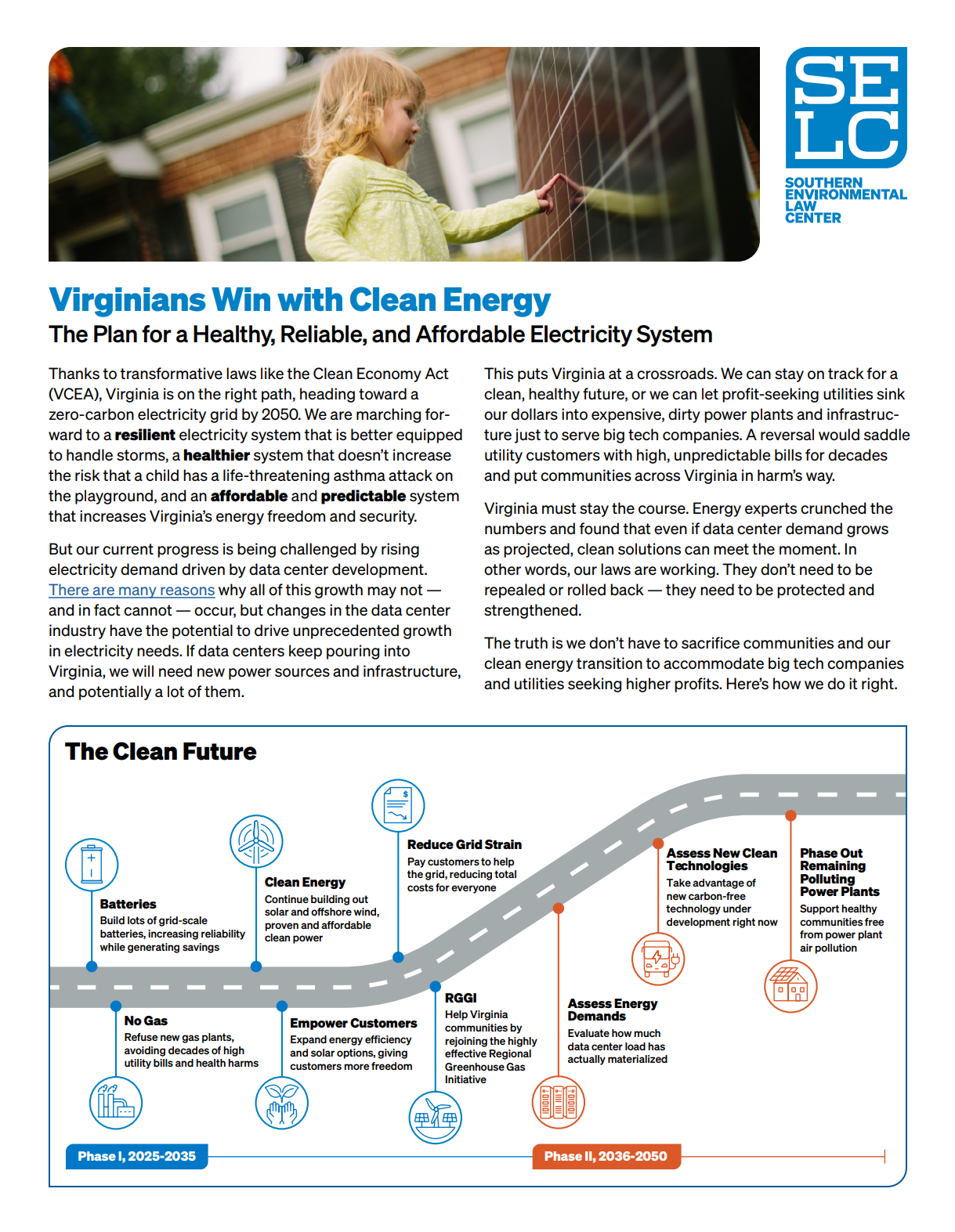
Build Batteries Not Gas
Virginia needs more batteries during this time of uncertain growth in demand for electricity. Batteries leverage existing resources and benefit customers immediately, giving Virginia time to assess data center needs and take advantage of promising new energy technologies.
Grid-scale batteries can provide huge savings to customers by charging when there is cheap, excess electricity (e.g., a sunny day with lots of solar energy), and then discharging when energy is more expensive (e.g., a very hot summer afternoon with air conditioners running at max).
Batteries can also help avoid the need to build dirty and expensive new power plants and big disruptive powerlines and other transmission projects. They can deliver critical power during storms and reduce outage times, providing reliability benefits on par with and often even greater than a gas plant.
Rushing to invest in gas, on the other hand, will saddle Virginians with high, unpredictable bills for decades to come. If the data center growth doesn’t materialize, everyday Virginians will be forced to pay for huge gas plants that sit idle most of the year. Moreover, burning gas produces harmful pollutants, including tiny particles that lodge deep in your lungs and cause serious health problems, with particularly acute risks to children. Increasing our reliance on gas will impose billions of dollars of health costs on Virginia communities.
Continue building out solar and offshore wind, proven and affordable resources
Utility-scale solar remains the cheapest form of generation, and every year it represents the majority of new capacity added to the grid. It can also be deployed in a fraction of the time of new gas plants, making it able to address near-term capacity needs without burdening nearby communities with harmful air pollution.
In addition to staying on track with Virginia’s utility-scale solar targets, Virginia can and should do more to steer as many projects as feasible to rooftops and previously developed sites like brownfields, landfills, and parking lots.
Offshore wind also represents an important clean and affordable source of generation. Dominion expects its Coastal Virginia Offshore Wind project to start producing energy in 2026. Once complete, it will be the largest offshore wind project in the country, producing 2.6 GW, enough to power over 600,000 homes.
Solutions benefiting all Virginians
Cutting carbon pollution can create a more equitable playing field for all Virginians.
Virginia’s participation in RGGI not only improved public health by reducing air pollution, it brought in hundreds of millions of dollars for the Virginians most vulnerable to climate change.
About half of the proceeds were devoted to communities in danger of flooding — not just on the coasts, but along Virginia’s rivers and on Main Streets through the Commonwealth. The other half funded upgrades to inefficient housing to cut low-income families’ energy bills, as well as to fund new energy-efficient affordable housing.
From the coasts to the coalfields, investments like these already made a measurable difference for Virginians who have historically borne the brunt of climate change. And with methane gas plants disproportionately concentrated in low-income and communities of color, cutting carbon also is an urgent matter of environmental justice.
Virginians Win with Clean Energy
Recent news on Virginia clean energy
Additional Resources

Gardening Tidewaters

Flood City

Uncharted Territory
Riding the Solar Coaster

Demand for Power