

How Helene redefined home
By Jay Leutze
I evacuated when the first bands of Tropical Depression Helene swept into the mountains of western North Carolina in late September. Most, including my friend Ashley Cook, did not. The region of vast forests and crystalline creeks is home to small towns where people straddle the divide between old ways tied to the land and the uncertainties of a digital future. Appalachia is both a refuge from climate change — it is cooler than the surrounding lowlands — and, as we were about to learn, its most recent victim.
A neighbor said he could feel it when a logjam a mile upstream gave way. Cars, tractors, livestock, and, yes, a woman — every last thing in the way of the floodwater was grabbed up by the floating opera of destruction, and sent downstream, right in front of his house.
When water falls from the sky it travels from high ground to low ground until it hits an impediment. Always. First, Big Horse Creek crashed into the North Toe River in the hamlet of Minneapolis. Down the waters went, down through several sawmill towns to join with the equally angry South Toe and the Cane River, which spilled from the shoulders of Mount Mitchell. Those waters had already thrashed the communities of Murchison and Micaville. Somewhere in the churn was Travis Bagwell’s house, my friend Edwina Tatum’s horses. Books from the library at the Celo Inn, pews from a shattered church. And so it went, through every riverside settlement until the confluence smashed the spillway at the point where the Nolichucky River is born. Between 24 and 30 inches of rain had fallen on the world’s oldest mountains.
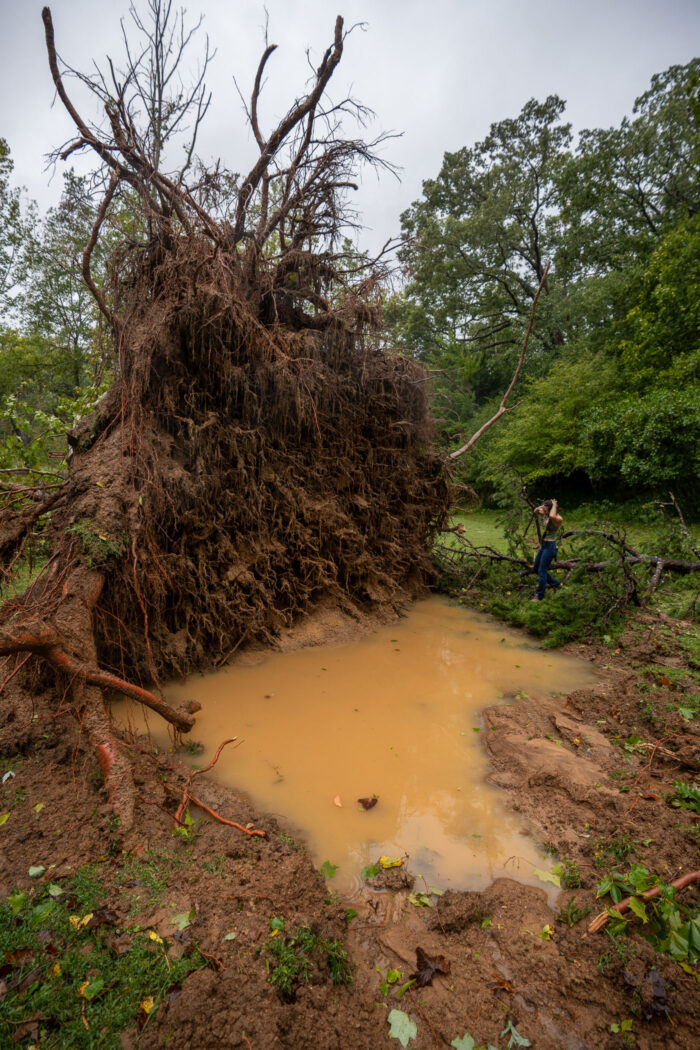
After the onslaught, the skies cleared and the water slid, mercifully, back into the banks of the creeks and rivers. Those who survived peered out at the changed world. In some places, where the wind was blocked by ridges, every tree stood as it had. In other places, up high in Pisgah National Forest, hundreds of thousands of trees lay flat, as if leveled by a scythe. My house, somehow, survived, but my road was buried under a wall of throbbing mud 6 feet deep.
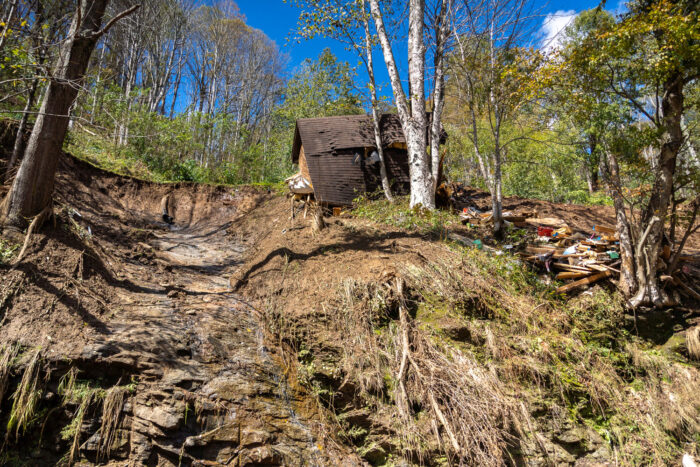
What we didn’t know in those first hours was that the disaster in the Toe River Valley was repeated on the Watauga River, and the Swannanoa, and on Garren Creek, and then, of course, all along the French Broad, which runs through downtown Asheville. Deaths were reported in the Upstate of South Carolina and the North Georgia mountains, and rumors of catastrophic damage to Erwin, Tennessee, reached us soon enough. Closer to home, the ruins of the town of Chimney Rock were floating in Lake Lure. It was days before we understood that some 2,000 landslides had scoured steep slopes across the region. Seventy-four thousand North Carolina homes were either gone or damaged and 12,000 souls displaced, with dozens unaccounted for. The casualties among fish populations, birds, and other wildlife, were beyond our ability to calculate.
Until lines of communication were restored, the people of the Toe River Valley did not know that they weren’t alone.
My first call from the disaster zone was from my friend Ashley Cook. We met 25 years ago when she tried to hire me to represent her in a lawsuit she hoped to bring to stop a gravel mine from operating next to her home. I had to inform her that I was not licensed to practice law and could not represent her, but we went on to stop that mine together and we worked arm in arm since the day we met. I am her unlicensed, and unpaid, legal consultant.
“What do you see out your window?” I asked, afraid to hear it. “I can’t describe it,” she said simply. And she wept.
Ashley calls when we need to solve a problem. We brought on legal experts from SELC and, for four years, we obsessed over motions before the Office of Administrative Hearings and filings before the Wake County Superior Court in our mining case. We endured endless appeals and a Writ of Supersedeas as our claim worked its way toward the North Carolina Supreme Court, where we were ultimately victorious.
Now we faced a new threat: the unraveling of our community. This natural disaster of biblical proportion would be a test of survival.
“What can I do?” I asked, helplessly far away. “You need to call somebody in Washington,” she suggested. “Tony Burleson has multiple excavators he’s ready to put to use but the rumor is FEMA has him shut down. He’s just trying to help people. People are going to die.” This was the word up and down the valley, that the Federal Emergency Management Agency (FEMA) was stopping equipment operators from working on state roads and private driveways. “Can you call FEMA? Or the governor? We need to get food and medicine to people.”
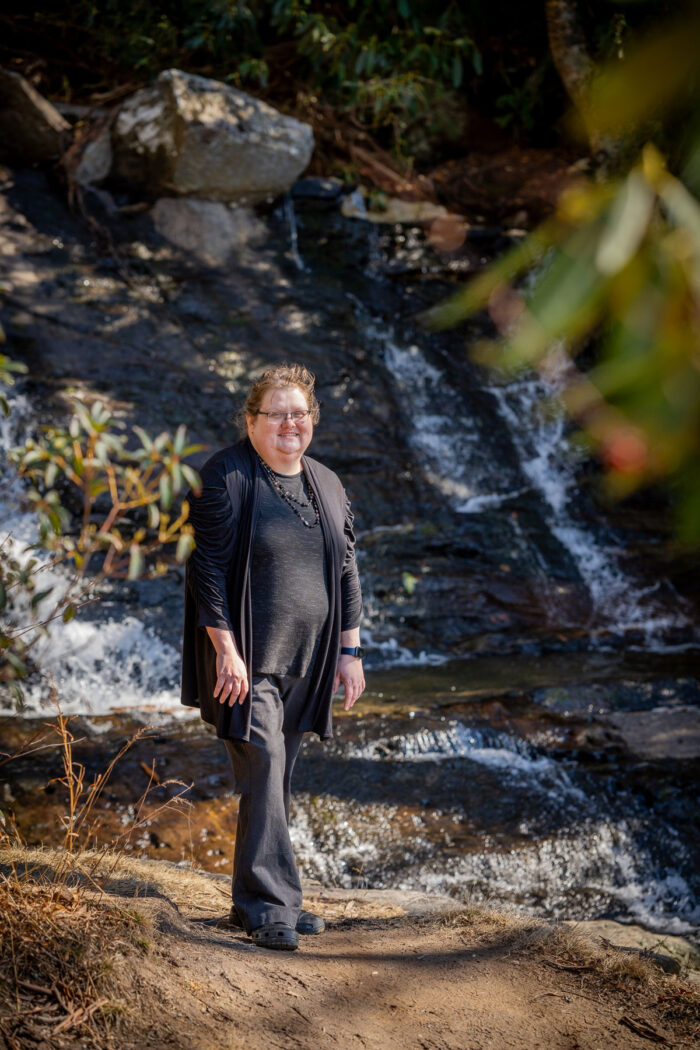
Ashley thinks I can do more than I can do. She quickly relayed other snatches of conspiracy theories being passed around the valley, just so I would know what we were up against. Rumors like the president was closing the airspace to private pilots who were trying to rescue people stranded on barn roofs. Another was that the government had steered the storm to Appalachia in order to seize lithium-rich land to power electric vehicles. I quickly realized that — absent television and radio, or even a phone signal — word-of-mouth information, much of it conveniently and patently false, was traveling at the speed of ATVs through western North Carolina. Ashley didn’t believe the wildest of these tales, but she wanted me to know what people were saying. And she wanted me to call somebody. To do something.
I didn’t call FEMA. I’m not sure how one does that. Instead, I called Tony Burleson. I’ve known his family for 50 years. By some miracle he had a cell signal, and he picked up. No, FEMA had not shut him down. He had a bad case of COVID-19, so moving a little slower than usual, but he was on an excavator, setting a culvert, when we spoke. One rumor laid to rest. There were many more to come.
In those first hours after Helene, fire stations became emergency distribution centers. Ashley and her cousin Freddy were critical spokes on the relief wheel. They would field requests then text me shopping lists. I, and a network of volunteers, would deliver what they needed. First it was tarps, Benadryl, and children’s acetaminophen. Then they needed six air mattresses and bedding. Hoses for the propane tanks that tie into portable heaters. Soon the needs list expanded to infant formula, then ready-to-eat meals, more tarps, and generators.
After the first week, it was clear the volunteer fire stations were taking on a larger role in the recovery. They became social clubs and prayer circles and dining halls in a region where people are known for sticking tight to family rather than to institutions. Outside of disasters, Appalachian people belong to their kinfolk and their creek. They are bound by common principles: be honest in your dealings and work hard. Have faith. Distrust of strangers and government is common, but generosity is rampant. Kindness and a sense of humor go a long way. But the storm upended the way of life for everyone in the region. Most who lost houses quickly found shelter with cousins or in church basements. Or, finally, for some, in distant hotels through FEMA vouchers. If you needed help with a washed-out road or a medical prescription or a hot meal, just ask somebody at the nearest fire station and help would soon be on the way.
Most people in the path of destruction had power restored within a month, a monumental feat in a region as rugged as this one. The skies were filled with military and private aircraft delivering supplies. Suddenly unemployed people cooked feasts for road crews and goodwill was in abundant supply as blessings were counted. Volunteers poured into the region to repair roofs and muck out living rooms and they received ovations while the search-and-rescue crews continued the grim hunt for the missing.
With the exception of one cloudburst and a freak snowstorm, western North Carolina experienced a month of blazing sunshine in the aftermath of the storm. The region went from historic flooding to near drought, with dead trees and drifts of stripped leaves turning brittle in unseasonable heat. A wildfire broke out near my house when the utility company tried to restore power to the downed line. Because my road was still buried by a landslide, there was no way for fire trucks or other emergency vehicles to access the conflagration. Instead, volunteers on four-wheelers streaked to the scene and put out the fire by hand (and foot) before it could spread. Is this our future? Violent storms pulling our forests down and then wildfires sending the debris up in smoke, along with life as we knew it? This is, after all, what the scientists warned us of.
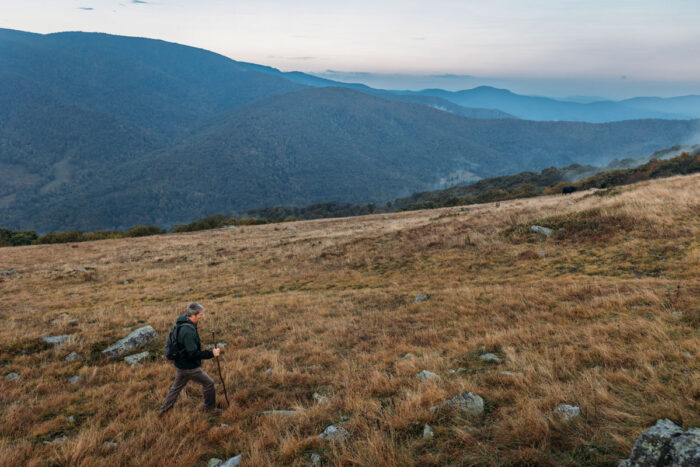
Appalachia is a land of myth and struggle, of plenty and of poverty. It has seen runs on its water, on its timber, and on its mineral resources. The majority of people have benefitted little from the pattern of extraction. Akin to economies in developing countries, its wealth belongs to a few titans while those who toil to enrich the boss often gain only hardship in the form of stiff limbs and diseased lungs. But it is also a land of natural wealth held in common. Expansive national forests and parkland boast streams teeming with fish; the woods are full of wild game. Springs are plentiful and spotless drinking water is free for the tapping. Biologists consider Southern Appalachia, in particular, a globally significant treasure chest of biodiversity. As a child, I enjoyed hiking the mountain summits for the views, but my eyes were always searching the low places, the cool creeks with slick boulders and glowing moss. Rhododendron shade and glades of skunky galax. Trout flicker in these places, where caddisfly casings cling to the undersides of polished rocks. And salamanders of every color and description lurk out of sight, playing their role in the intricate web of life. The threat to all this abundance of life posed by rising seas and climbing temperatures has seemed far away from Appalachia. Until Helene. Until now.
In the post-storm haze, we have to revisit the questions long raised by climatologists: what will it take to reckon with the challenge of a changing climate? And will we do it? Can we afford to, or have we already missed the opportunity? There are currently 220,000 bridges in our country in need of repair or replacement. In the coming floods, they will be the first to go. But the federal purse is strained by past disaster events in eastern North Carolina, in Kentucky, and in Vermont. Responding to the recent wildfires in Hawaii and Los Angeles will cost hundreds of billions of dollars. Will we muster the resources to prepare our infrastructure — and our communities — for the change that is coming? The change that is here.
In 2013, North Carolina’s legislature eliminated the commission charged with identifying landslide hazard areas in our mountains — calling it an unnecessary waste of money, and calling climate science “speculation” despite studies showing the risks to human life when (not if) flooding rains visit the region. But, as the saying goes, science doesn’t care whether you believe in it or not. Would further investment in steep-slope mapping have provided fair warning to my neighbors who were swept away by waves of mud and macerated timber? Those drafting budgets in Congress and in state legislatures will have to wrestle with whether it is more cost effective to save lives through planning or to roll the dice and clean up after the inevitable. They will determine the fate of these places we call home. And voters have to decide if we will demand action or cede the future to a monster — at least partially — of our own making.
And then there is the more practical, and pressing, matter of the buildings we call home. Those displaced by Helene need housing now. Some want to write a new building code that will keep this disaster from repeating itself. Houses must be raised on stilts, they say, or be built upslope away from the water. But if you own half an acre of steep land, it is not always feasible to move up the slope. And elevating houses 12 feet is expensive, especially for underinsured people who have lost everything to the storm. Some want to cut red tape to expedite rebuilding. This is an emergency, after all, and there are people living in campers in their yards. In fact, since Helene, North Carolina has waived regulations, relaxing fire safety codes to spur construction of short-term housing and eased permitting to lower costs. What that sometimes looks like is 8-by-12-foot sheds constructed by well-meaning volunteers. Ashley calls the cheapest of them “dog houses” and is now advocating passionately for building what she calls “housing with dignity” for storm victims. Thankfully, North Carolina’s governor recently appointed her to serve on his Rebuilding Western North Carolina Recovery Committee.
After Helene, we conservationists worried that every living thing — fish, hellbenders, mussels — had been ripped from our waters, swept away for all time. But as I recover from the shock of an altered landscape, a new reality, I am reminded that our native brook trout move upstream to expand their range, to explore new habitat, to seek ever colder and cleaner water. But these Ice Age holdovers can only migrate when waters are high enough to provide “ladders” to upstream pools. They can scale sheer cascades, even small waterfalls, but only during deluge. There would be no brook trout at the heads of the shoulder-thin creeks of Appalachia without periodic floodwaters to climb.
I waited until I felt strong enough to absorb bad news, and until essential search-and-rescue operations concluded, before setting out for a survey of the terrain around my mountain home. I headed away from the benighted North Toe River and up into a holler between Big Yellow Mountain and Grassy Ridge. I explored the headwaters of my favorite creek, looking for signs of life, for fish. I climbed up deep into a notch between flanks, where the waters first start to gather. Not with a fly rod, I was just out scouting, taking stock of this new world, this post-apocalyptic realm. Here, in this sheltered cove, the forest held. And there, in the low winter sunlight glancing off a shelf of wet bedrock, I saw what I was looking for, the telltale shadow on a gravel bed. Then the white fin tips, billowing in the gin-clear current. Brook trout remain in this place, after all. As if nothing has happened, nothing has changed.
I will let this storm and this aftermath, and certainly this trout, this survivor, be a lesson to me. I will trust science and prepare for more upheaval, more uncertainty, but I will also cling to a less rational hope, that, if we use all of our abilities, and all the strength of our communities, we, too, can persist in these mountains. I know Ashley Cook, and her cousin Freddy, and the many heroes who led the first response to Helene will be there with me, and for me, the next time the rivers rise.

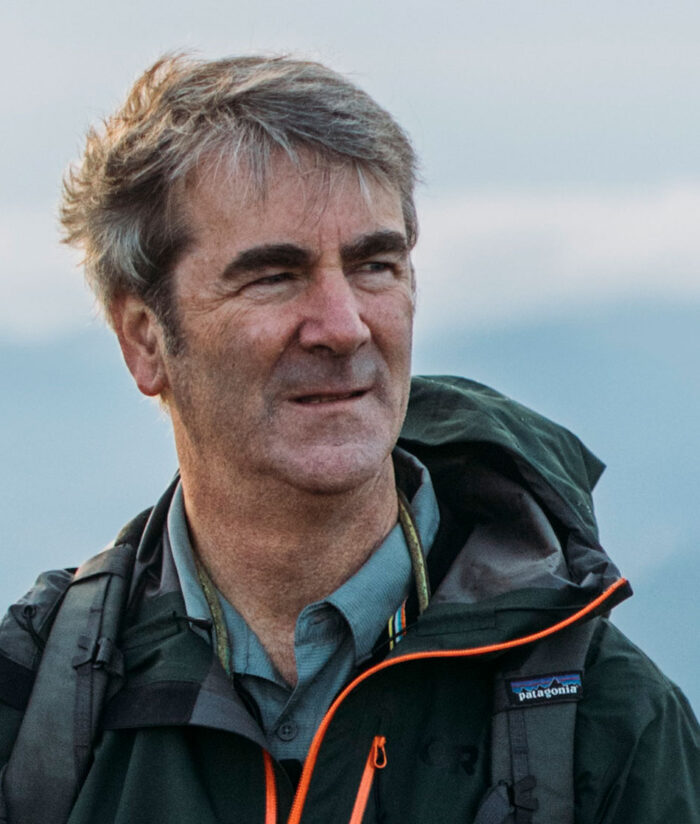
Jay Leutze is an award-winning writer and senior advisor to the Board of the Southern Appalachian Highlands Conservancy. His book, “Stand Up That Mountain,” about the campaign to stop the Putnam Mine, won SELC’s Reed Environmental Writing Award in 2012.
He lives in Minneapolis, North Carolina.