Earth Month dialogues: Protecting the world’s last red wolves
Written by
SELC Staff
Species loss is not inevitable says journalist and Reed Award winner Lindsey Liles.
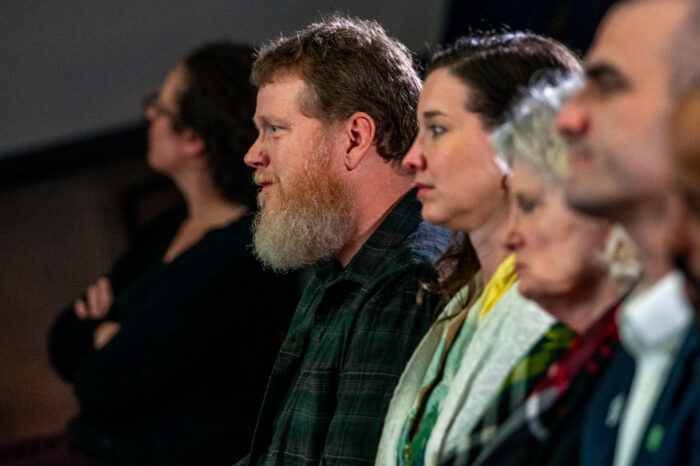
Journalist Lindsey Liles is the recipient of this year's Reed Environmental Writing Award for her story that illuminates the past and present of red wolf recovery efforts. (Stephanie Gross)
Lindsey Liles accepts this year’s Reed Environmental Writing Award for the journalism category. (Stephanie Gross)
The red wolf’s only remaining wild population survives in a small corner of eastern North Carolina. Its future hangs in a delicate balance shaped by conservation efforts, public policy decisions, and the complex relationship between people and the environments they share.
She underscores how protecting wildlife is never just about the animals. It’s also about human relationships, land stewardship, and the choices we have the power to make about the future of our natural world.
Lindsey centers her award-winning piece around the people, ecosystems, and stakes involved — reassuring us that species loss is not inevitable.
After her story was published, we learned the great news that 2025 was a banner year for pups, with the wild population now up to 26 known wolves. It’s a reminder that the survival of the red wolf remains possible if we choose to act.
SELC has worked for decades, through litigation and advocacy efforts, to protect these remarkable animals. We’re grateful Lindsey is helping readers better understand the work to protect the fragile ecosystems of our region.
Read the interview with Lindsey below.
How did you react to seeing your first red wolf?
Lindsey Liles: The first red wolf I saw was in captivity at the North Carolina Zoo, but just seeing an animal like that move around and knowing that we used to have so many of them across the Southeast was incredibly impactful.
A few years later, I went to the reintroduction area in Eastern North Carolina and saw one in the wild. It was a young male and it was from a distance. To see something so rare and endangered is very inspiring and it gives you a sense of both the fragility and the resilience of the species. I’ve only seen one red wolf in the wild, but I feel very lucky and hope one day more people will have the chance to see them.
Will you share another memory from your reporting that made a big impact on you?
Joe Madison (left) is the Red Wolf Recovery Program Leader with the U.S. Fish and Wildlife Service. (Stephanie Gross)
Lindsey Liles: It was getting to know and becoming friends with Joe Madison, the Red Wolf Recovery Program manager with the U.S. Fish and Wildlife Service. I reported this story over multiple years and saw firsthand the amount of work that goes into recovering this species. Joe’s team does not cut any corners. They’re up against incredible odds that are largely human-created and they cannot afford to make any mistakes.
They have to cope with things like red wolves dying under mysterious circumstances and being hit by cars. It’s hard to imagine what they go through when they lose one because they know every detail of that red wolf’s life. It really takes a deep emotional toll on them. In getting to be friends with Joe, I experienced the human side of how hard this is and it honestly took a toll on me, too.
It’s inspiring to see them forge ahead in the face of so many difficulties and huge amounts of misinformation around the species.
How has representation in fairytales and folklore harmed this species?
Lindsey Liles: It’s easy to fear things we don’t understand. When you look at an apex predator like a wolf, they can look scary. I think we’ve made them a symbol of something ferocious, something that will come and attack or eat you. If you run through the depictions of wolves that you’ve seen, you would probably come up with Little Red Riding Hood or Beauty and the Beast.
When you’re watching these things, that message is embedding itself in your subconscious and you’re thinking, “Ooh, wolves are something to fear.” But it’s not based on information about them. A red wolf is not going to attack you. They’re incredibly afraid of humans. We’ve just mapped our own hatred and fear onto them, not based in fact at all. And hopefully we can do a little better.
Why do you think red wolves’ history and recovery is an important story to tell?
Lindsey Liles: In eliminating an apex predator like the red wolf, you’re changing ecosystems from every level on down. It’s hard for us to even imagine what the South would look like if we had red wolves as we used to.
The country can be divided into three main zones: We have gray wolves out West, coyotes in the central plain states, and then red wolves in the East. In removing red wolves, coyotes have expanded their range into the South.
What I think most people don’t realize, and I certainly didn’t before I started reporting this story, is that we’re going to have some canid in our ecosystems, and it’s supposed to be red wolves. Red wolves lived across the Eastern Seaboard for thousands and thousands and thousands of years. Now, because of what we’ve done, we’ve got coyotes.
If it’s a matter of choice, then we have chosen coyotes when we need red wolves.
Why should the average person care?
A wild red wolf. (Neil Jernigan)
Lindsey Liles: I talk to my family about this a lot. Aside from going through the trophic cascade and the food chain, this is a majestic animal that was here so long before colonization started. Red wolves have a right to be here more than most of us do. I think they have intrinsic value very much apart from humans. It’s hard for us to step out of our human perspective and think about that, but they deserve to be here.
The entire historic range of this wolf species lies in the United States, so it is truly an American wolf. Land and wildlife are so important to us as Southerners. I think we can tap into that sense of pride. One thing we can all agree on is that protecting our natural heritage is important.
What other conversations do you want your story to inspire?
Lindsey Liles: I hope people ask themselves, “What have I consumed about wolves? Is it based in fact? What could I learn about them? And what might I learn from putting my human perspective aside?”
I hope that people read this and realize the South is home to a whole world of biodiversity that most of us don’t see. I hope it makes people curious about what this region used to look like and what it might look like again.
What drives your interest in environmental advocacy?
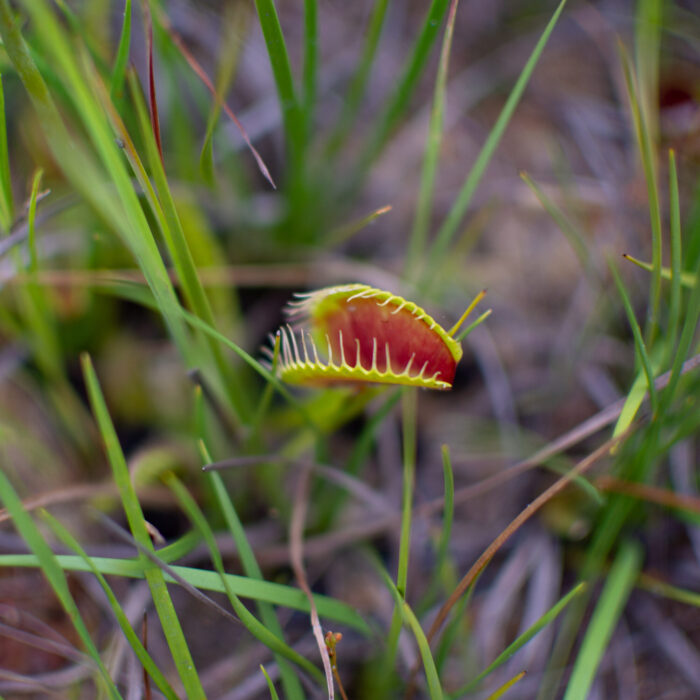
A venus flytrap grows at the Stanley Rahder Carnivorous Plant Garden in Wilmington, N.C. (Sam Lewis/SELC)
Lindsey Liles: Years ago, I was out in an old growth forest and looking at a mossy rock face. There was a green salamander crawling across it and I was just thinking about that creature over an unimaginable timescale evolving to blend into that mossy rock face. I just love thinking of our wildlife and our plants as evidence of deep time and ancient stories.
Nothing about their bodies is an accident. A lot of these hyper-specialized species that we have are only found in one little pocket of the South, and they’re so representative of place in a way that we don’t often think about. To see a Venus flytrap in the coastal plain of North Carolina is just so amazing.
Have any themes emerged in your ongoing coverage of the South?
Lindsey Liles: One thing that I often come across in talking to biologists is that a lot of the creation of national parks happened later in our history as a country. And so the East was already pretty heavily developed before we started saying, “Let’s set aside huge pieces of land like Yellowstone.”
What that means for the South is that the vast majority of our land is in private hands. And so whatever we do here in terms of protecting the environment is going to have to happen on private lands.
I think it’s important for a biologist who’s recovering an endangered species to hear what the landowner wants their land to do, and vice versa, that the landowner has an open mind to how they might optimize their lands in order to host native wildlife. Working lands like forests, timber management, agriculture, cattle ranching — all of that can absolutely be a win for wildlife as well. These things do not have to be at odds.
What’s next for you?
Lindsey Liles: My next feature is going to be about the black rail, which is a very elusive coastal bird found in the salt marshes of North Carolina, South Carolina, and Florida. It’s a story that’ll tie climate change and coastal development to our changing coastlines.
I’m also working on a feature about cave art in the region, which is meant to coincide with the celebration of 250 years of America. There’s actually been a very long human history here. Humans have been in North America for 20,000 years and they left evidence of that through incredible artwork that often appears in caves in the Southeast.
Tell us about going underground.
Lindsey Liles: I was laying in this cave and four feet above me was a drawing — a mud cliff of an Eastern diamondback rattlesnake that somebody made over 2,000 years ago. I was just laying there thinking somebody 2,000 years ago saw this animal that is still on our landscapes today, and they drew it here, and now I’m looking at it.
The cave art story made me think again of what early native people were seeing and how we’re still seeing some of that today, but we could lose it. We feel so separate from the environment when we’re living in our cities and insulated in so many other ways, but we are so much a part of it as well.
We’ll evolve the same as any of these other things evolved. I hope we can feel a little more connected because I think that’s the start of protection and caring.
What do you see as your role in helping to protect our Southern environment?
Lindsey Liles: I try to be a good storyteller. I feel like if I can somehow package and capture my excitement about these species and places, then maybe I can export it to the public.
There’s more to learn about the fight to save wild red wolves.