

Michelle Lanier: What the Land Witnessed
A “keeper of memory” and Director of the North Carolina Division of State Historic Sites, Michelle Lanier has built a career on understanding layers of history underlying our Southern landscapes, not just battlefields and burial grounds, but native pine forests as well. Prized for their lumber and “bled” for their multipurpose pine gum, Longleaf pines were exploited, much as the enslaved and indentured laborers forced to harvest them were. Today, though few Longleaf pines remain, echoes of this exploitation endure in the Black Southern communities now battling the biomass industry.


Dig deeper. Explore more Plantations to Pollution stories.
Episode Transcript
BROKEN GROUND SEASON 8
MICHELLE LANIER: What the land witnessed
[MUSIC IN HERE]
Michelle Lanier: If you are in a woodland space in North Carolina, you might stumble upon an old tree that still has that scar tissue from being bled.
HOST: In this episode of Broken Ground, we’re traveling back in time to learn about one of our region’s earliest, most environmentally destructive industries …
Dr. Albert Ike/Spirit of the Pines: It’s about pine trees and it’s about turpentine. But it’s really about people. It’s about the people who lived in these woods and camps and who made turpentine from these trees. What you will see and hear is both raw and real.
Michelle Lanier: The same way my people were pulled out of the continent of Africa and exploited for labor is the same way the pine trees are bled for income.
HOST: What scars did the turpentine industry leave? And in what ways does the industry still echo in our woodlands and communities today?
[MUSIC ECHOING, UP AND OUT]
[BROKEN GROUND THEME MUSIC IN HERE]
HOST: This is Broken Ground, a podcast by the Southern Environmental Law Center. I’m Leanna First-Arai, your host. Here at Broken Ground, we dig up environmental stories in the South, and introduce you to the people at the heart of them.
[BROKEN GROUND THEME MUSIC OUT HERE]
HOST: This season, we’re exploring the root causes of some of the environmental injustices communities face throughout our region. The digging continues online with SELC’s multimedia storytelling series “Plantations to Pollution: Black Communities, Legacy Pollution, and the Path Forward.” I hope you’ll check it out.
[SAWING/GRINDING/CONSTRUCTION SFX]
HOST: If you listened to our previous season, you already know that our Southern forests are under threat from the growing biomass industry. That’s the industry that grinds up trees and turns them into pellets to fuel power plants abroad. Not only is this terrible for our forests and our climate, it’s also pretty awful for the folks who now have to live with noisy, polluting pellet factories in their neighborhoods.
[MUSIC IN HERE]
HOST: But … this isn’t the first time our Southern forests have been exploited at the expense of the people living and working in them. Back in the 1800’s – across much of the same area now being ravaged for biomass – the turpentine industry began chewing through North Carolina’s native Longleaf pine forests. Fueled initially by slave labor and and then, essentially indentured African-American workers, this industry was not just brutal … it actually helped propel the transatlantic slave trade. And, as we’ll learn, it also has had a long-lasting impact on the landscapes in which we live today. We’ll come back to that shortly with the help of our guest.
[MUSIC OUT HERE]
Michelle Lanier: My name is Michelle Lanier. I am a keeper of memory, a writer, an educator, a filmmaker, and I’m a trained folklorist. Additionally, I’m someone with deep roots in North Carolina.
[MUSIC IN HERE]
HOST: Michelle is also the Director of North Carolina Historic Sites, which means she oversees 27 historically important locations around the state, including archaeological sites, a former plantation, and Civil War battle fields, among others.
Michelle Lanier: North Carolina, what is attractive to me is it’s, it’s a knot that you will never untie in terms of the layers and layers and layers of history. But that actually keeps me coming back and it keeps me excited to invite people in.
Leanna First-Arai: Michelle, in conducting our research for this episode, we came across a presentation you delivered titled “What the Land Witnessed.”
Michelle Lanier: Yeah.
Leanna First-Arai: Can you tell us more about the origin of that idea?
Michelle Lanier: I was a little girl who loved to wander about. So the concept of the land as being like a text that could be read in a tactile way was something that I understood very, very young.
Leanna First-Arai: Hmm.
Michelle Lanier: I’m thinking about a concept that I call ‘ecosystems of witness’ – what are the ecologies that were witness to my ancestors and other people who have ancestry in North Carolina – what the land itself witnessed.
[MUSIC OUT HERE]
Leanna First-Arai: One of the big questions that we’re grappling with throughout this season of the podcast is just looking at how understanding histories at sites across the region can help us better understand the anatomy of some of our social problems. How do you think about that question in terms of all of the histories that you are a steward of.
Michelle Lanier: If I’m thinking about the through lines of historic narratives to the current moment that we’re living in, there is, there’s nothing that we’re experiencing in the current moment that we can’t look to our past for some sort of food and medicine to carry us through.
Leanna First-Arai: Hmm. So, one of the topics that we’ve spent a lot of time kind of investigating on the podcast is the human and environmental impact of the wood pellet industry. According to pretty conservative estimates, we’re talking about a hundred thousand acres of southern forest that have been cleared every year for wood pellets. And one of the things that we’ve started to open up our thinking to is going back further than, than we had before, connecting now the biomass industry ills to the loss of native trees. I’ve heard you call that in some way ‘the predecessor story.’ Could you just unpack a little bit this predecessor story when we’re talking about what the land has witnessed over all of these generations?
Michelle Lanier: For millennia …
[MUSIC IN HERE]
Michelle Lanier: … before European contact and before the transatlantic slave trade as it impacts North Carolina specifically, we know that the Longleaf pine covered much of, of this land that we now call North Carolina.
Leanna First-Arai: Not everyone can conjure an image of Longleaf pine, so could you just quickly describe the Longleaf pine?
[MUSIC OUT HERE]
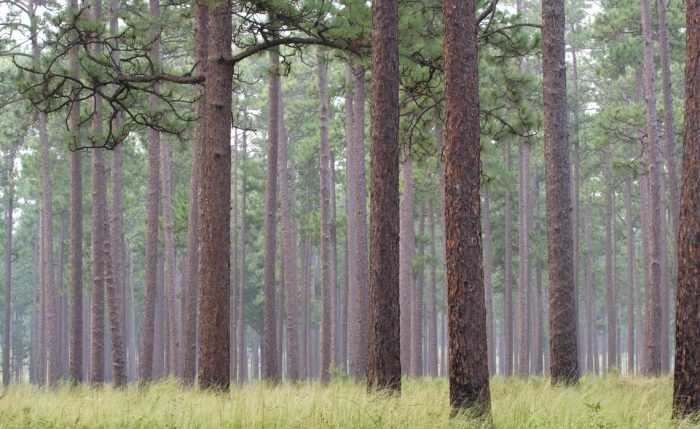
Michelle Lanier: You can imagine by its name, the needles are extremely long. Even when it is in its youngest phase of growth, when it is really just a little sapling, it looks like a green, kind of, bottle brush that has just lifted out of the ground. I often say that it looks like kind of a green – if you know the Cousin It character – as if it’s gonna walk towards you when it’s young. And then they grow very, very tall. If they’re left alone, they can grow extremely thick as well. And their pine cones are giant, like the size of a, a grownup’s head.
Leanna First-Arai: Wow.
Michelle Lanier: Huge pine cones. There are pine nuts, there are nuts inside of these pine cones. But there’s also medicinal uses for those needles. You could make teas from those needles. They’re very rich in vitamin C.
[MUSIC CREEPS IN HERE]
Michelle Lanier: And with Europeans coming in and settling in the 1600’s and 1700’s, they’re realizing that these trees are an incredibly powerful economic driver.
HOST: Because the Longleaf pines grew so straight and so tall – often more than 100 feet – they were prized for their lumber. But even more so than the wood or the pinecones or the needles, the pine product that Europeans – particularly the British navy – really clamored for in the 1800’s was what they called “naval stores.”
Michelle Lanier: The phrase “naval stores” because what is bled out of these pine trees – the liquid that is inside of them – is transmuted into turpentine, tar and pitch.
[MUSIC OUT HERE]
Michelle Lanier: And turpentine, tar and pitch are incredibly important to boats – the navy, the naval stores – makes these ships water tight. It is necessary. So barrels and barrels of turpentine, tar and pitch shipped over to Europe and then ultimately the northeastern United States where there’s a lot of shipbuilding that’s happening.
[DOCUMENTARY MUSIC IN HERE]
HOST: So many barrels were shipped, in fact, that by the mid 1800’s, the top three exports from the American South were cotton, tobacco … and naval stores.
Narrator/Suwanee Pine: From the living pine of the Deep South comes one of our most picturesque and important agricultural industries …
HOST: This is a clip from a 1940’s era documentary titled “Suwanee Pine.”
Narrator/Suwanee Pine: This industry presents a thrilling chapter in the story of American ingenuity and progress.
HOST: Its patriotic tone seems pretty discordant today, given what we know about naval stores’ impact on the land and its laborers, but it does speak to how important the industry was at the time.
Narrator/Suwanee Pine: From these pines comes the raw product called gum, the source of gum rosin and spirit of gum turpentine.
HOST: You’ve probably heard of turpentine. It’s that really strong-smelling liquid you can buy at the hardware store that can clean a paint brush or help thin out an oil-based paint. That liquid is made by heating – or ‘distilling’ – the sticky gum bled out of pine trees. In producing this episode, we’ve been genuinely surprised to learn just how many other items pine gum has been used to make over the years, including:
Lawrence: Shoe polish
Sarah: Adhesive tape.
Suwanee Pine Announcer: Insect powder.
Cedric: Linament for sore muscles.
Suwanee Pine Announcer: Soaps.
Kyle: Cigarette paper.
Paula: Axel grease.
Vernon: Antiseptic.
Suwanee Pine Announcer: Why, even waxed crayons contain gum products.
HOST: You could think of pine gum as the equivalent of petroleum today, which we use not just for fuel, but in fertilizers, pharmaceuticals, plastics and countless other products. Pine gum was equally multipurpose. And the vast majority of it came from native Longleaf pines growing right here in the South.
Narrator/Suwanee Pine: The United States produces about 75% of the total world supply of these important farm products. All of this comes from a group of eight southern states reaching from North Carolina to Texas.
HOST: Did you know that this is why North Carolina was nicknamed “the Tarheel state”?
[MUSIC IN HERE]
HOST: The pine tar produced by slowly burning Longleaf pine debris stuck to everything, including the laborers’ feet. Back then, “Tarheel” was meant as an insult, meaning, basically filthy, poor, maybe uncouth … but it has since come to be embraced by North Carolinians. Still, it’s a reminder that producing turpentine, tar and pitch was dirty and difficult work.
[MUSIC OUT HERE]
Michelle Lanier: You can imagine being out in woodland spaces, sometimes having encampments. You would have a tree in the process of harvest. They would make what’s called “cat eyes,” these cuts inside the tree that would not kill the tree, but would injure it so that it is bleeding. I call it bleeding.
Leanna First-Arai: Mm-hmm.
Laborers/Spirit of the Pines: Oh you? Ohh! Aw. Oh you?
Narrator/Spirit of the Pines: Each worker calls his special sound to the tallyman who keeps track of the work in progress.
Laborer/Spirit of the Pines: Oh you!
HOST: This sound is from “Spirit of the Pines,” a 1978 University of Georgia documentary that attempted to capture the last vestiges of the turpentine industry as it was dying out. In the film, one worker – a “chipper”– makes it clear just how dangerous hacking away at the trees to get the pine resin could be. It’s a little hard to understand, but he says, “You got to pray to keep from killing a man.”
Laborer/Spirit of the Pines: You got to pray to keep from killing a man. You got to pray to keep from cutting him and you got to pray for him not cutting you.
[MUSIC IN HERE]
HOST: And the danger didn’t end with the chipping of the trees. The barrels of sticky resin that were collected then had to be distilled in so-called “fire-stills.”
Michelle Lanier: You had fire for the extraction process, which meant that this was very explosive work. Um, you hear people talk about “fat wood.” It’s called fat wood because it’s saturated naturally with a liquid that’s very flammable. People use it even now if they’re trying to set a little fire. It being very flammable can be useful, but it also means that it’s very dangerous. So there were explosions, there were people who suffered critical injuries.
HOST: And the turpentine camps where workers labored were often very remote, as much as ten or even twenty miles from the nearest public road. So there was no easy trek into town to see the doctor.
[MUSIC OUT HERE]
Michelle Lanier: If someone needed to get treatment for a burn or for a gash from an injury of a log falling on you or a tree falling on you. Or if someone was running and put in stocks and had frostbite, there was not anesthesia to help if someone needed an amputation. And so the labor of producing these naval stores is incredibly dangerous and a real driver in the transatlantic slave trade.
[MUSIC IN HERE]
HOST: By 1860, just before the start of the Civil War, some 15,000 enslaved people labored not on cotton plantations but deep in the Longleaf pine forests across the South.
Michelle Lanier: Some of the first Africans that are brought to North Carolina are extracting what becomes turpentine, tar and pitch out of these Longleaf pine.
HOST: According to Tapping the Pines, a seminal book on the turpentine industry by Robert B. Outland, living conditions at these secluded turpentine camps were some of the worst that enslaved laborers endured. Shoddily built shacks, too little food, a scarcity of clean water, malarial mosquitos, saw palmetto that would slice through bare feet. And many camp owners didn’t hesitate to whip or otherwise punish their workers for perceived infractions – or for attempting to flee.
Michelle Lanier: There is a, a world of brutality people are experiencing at this moment in history that creates generations of trauma. And in many cases, people did not survive some element of that.
HOST: The brutality of the industry continued well after slavery was abolished at the end of the Civil War. In fact, in Georgia and Florida, prisoners – often arrested under trumped up “vagrancy” laws – were leased out to turpentine camps, where more than a few were worked, or beaten or shot to death by their overseers. But even, quote unquote, “free” people who labored in these camps were often effectively indentured servants.
[MUSIC OUT HERE]
Narrator/Spirit of the Pine: Turpentine camps were very paternalistic places.
HOST: This is from the film “Spirit of the Pines” again.
Narrator/Spirit of the Pine: Every camp had a commissary where workers could get provisions on credit. Debts were deducted each payday and many workers stayed tied to the producer by debt almost as effectively as during slavery.
[MUSIC IN HERE]
HOST: By 1920, half a century after emancipation, the vast majority of turpentine camp laborers were still Black men. And the vast majority of camp bosses and “woods riders” – men on horseback who surveilled the workers and kept them in line – were white. In addition to the human toll, the turpentine industry took a tremendous environmental toll.
Michelle Lanier: There came a, a, a moment where North Carolina’s, um, Longleaf pine was almost harvested into extinction.
HOST: Although “bleeding” the trees wasn’t MEANT to kill them, the resin would eventually stop flowing … at which point the trees would often be cut and sold for timber or pulp. That’s assuming, of course, that insects or drought or fire didn’t finish the weakened trees off first.
[MUSIC OUT HERE]
Michelle Lanier: As you see these forests being depleted, you see the moving of people from one part of the country to another, almost chasing the trees.
Leanna First-Arai: Interesting.
Michelle Lanier: And then behind that, you see other crops coming in. As one crop gets to a place where it’s no longer viable, then these same planters are saying, okay, then we need to do grain. Okay, then we need to do rice. Okay, we need to do cotton. Okay, we need to do tobacco. And then we see the soil becoming increasingly depleted with monoculture. We see drought, we see erosion. We see kudzu coming in as an erosion technology that then goes wild and is uncontrollable.
[MUSIC IN HERE]
HOST: The naval stores industry peaked around 1908, when producers extracted three-quarters of a million barrels of turpentine and two million drums of rosin. Given that the trees were also being harvested for timber, the Longleaf pine stood little chance of surviving. By the 1990s, 97% of our original Longleaf pine forest was gone, in many cases replaced by cropland. According to the Nature Conservancy, that level of ecosystem loss is one of the most significant EVER recorded, surpassing even the loss seen in the Amazon rainforest.
[MUSIC OUT HERE/IN HERE]
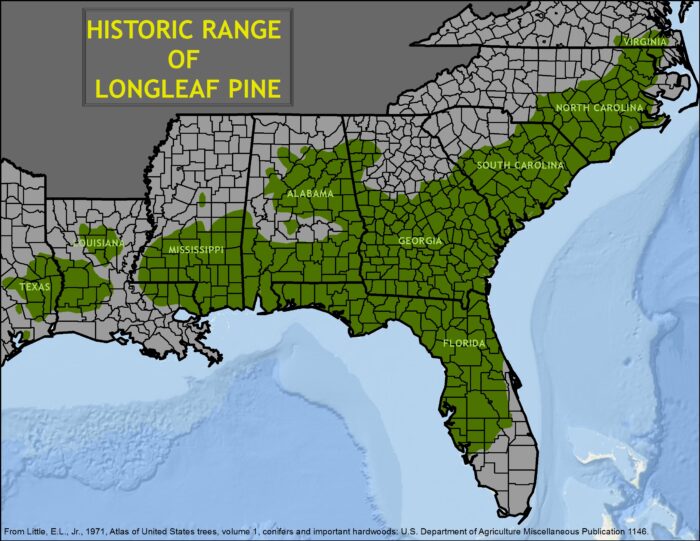
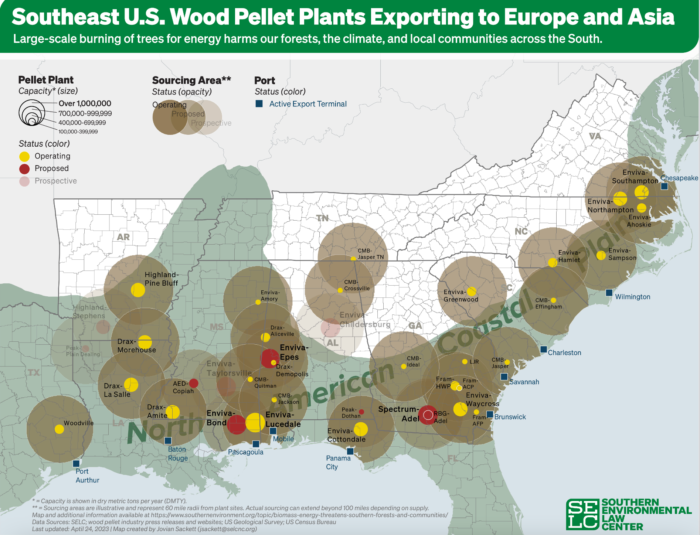
HOST: But … that wasn’t the end of the exploitation of the region’s forests and its people. Here at Broken Ground, we’ve noticed a number of disturbing parallels between the naval stores industry and what today is known as the biomass industry – specifically wood pellet manufacturing, which we covered last season. Today, the biomass industry is focused heavily on the Southeast, threatening much of the very same region targeted by the naval stores industry in the 19th and early 20th centuries. In fact, we layered an historic map showing the original range of Longleaf pine forests over a map of current biomass plants, and my goodness, there’s a LOT of overlap. That has resulted in a drastic change in the quality of life for people who live near pellet plants, and are forced to deal with the 24-hour a day noise and dust. Folks like Kathy Claiborne, who we visited last season at her home in Gaston, North Carolina, right next door to an Enviva pellet mill.
[MUSIC OUT HERE]
Kathy Claiborne: It’s like something is dropping in a machine and it’s, and it’s really loud, like BOOM! I guess my body now got adjusted to it, I can’t sleep at night.
[MUSIC IN HERE]
HOST: Another parallel between the two industries? What they leave behind. In short … not much. The author of “Tapping the Pines,” once described the extractive nature of the naval stores industry in this way: “Everywhere you see the naval stores industry,” he said, “it seems to center in areas that are poor, and when it leaves, it LEAVES those areas POOR … There’s no economic development … no businesses spun off from these backwoods operations.” Outland could just as easily have been talking about the biomass industry – at least according to the people that we’ve spoken with who live in pellet mill communities. There’s very little economic development in the wake of either industry, and with both, the forests themselves are sacrificed.
[MUSIC OUT HERE]
[SAWING/GRINDING/CONSTRUCTION SFX]
HOST: Just in the last decade over a million acres of southern forests have been cut and ground into pellets. If those trees are then replanted – and they often aren’t – in some cases they’re replaced by a single, fast-growing pine species that can be harvested again in as little as 10 years. In other words, you could argue that the biomass industry – like the naval stores industry before it – is replacing forests … with crops.
[MUSIC IN HERE]
HOST: These monoculture pine plantations not only reduce biodiversity – in terms of trees, birds, flowers, bugs, you name it – they also just, kind of, diminish the landscape.
[DRIVING SFX]
HOST: If you’ve driven through the rural South lately, you’ve probably seen a pine plantation or two. With trunks all packed together and little room for daylight to shine through, they aren’t much to look at. I’ve never heard anyone say THIS about a tree on a pine plantation:
Michelle Lanier: When I see a baby Longleaf pine, that’s all, you know, like, just resplendent in these long, gorgeous, bright green needles. And I see that it’s thriving and I see that, you know, some good land steward has done a controlled burn to clear the forest so that those turkeys come waddling in and eating the grubs that have been toasted by the fire and the woodpeckers come back. That, to me, is a sanctuary for my soul because it is a space that I can most beautifully speak to my ancestors because I know that that’s what the land looked like when they first came here.
[MUSIC OUT HERE]
Michelle Lanier: And that is worthy of contemplation, that’s worthy of getting in a train or a bus and getting closer to these spaces.
Leanna First-Arai: Mm.
[MUSIC IN HERE]
HOST: Since 1990, the Longleaf pine HAS had a small resurgence – rebounding from only about 3% of it’s original forests back up to almost 5%.
Michelle Lanier: Thankfully there was a lot of wisdom over the years, particularly as we get into the 20th century, around protecting the stands of Longleaf pine, those old growth stands that were still untouched.
HOST: As a public historian, Michelle Lanier says preserving the Longleaf pine is not just about preserving biological diversity, though that’s obviously very important.
[MUSIC OUT HERE]
Michelle Lanier: Because when we’re telling these stories about a time, it is most evocative if we can also invite our audiences into the experience of a space and a place. Not just through an artifact, which are important – things like quilts and cannons and clothing. All of this is very, very important. But the land itself is also a text. It’s a kind of living artifact.
Leanna First-Arai: Speaking of texts, you actually wrote a children’s book that mentions the Longleaf pine.
Michelle Lanier: Yes.
Leanna First-Arai: Can you tell us about that?
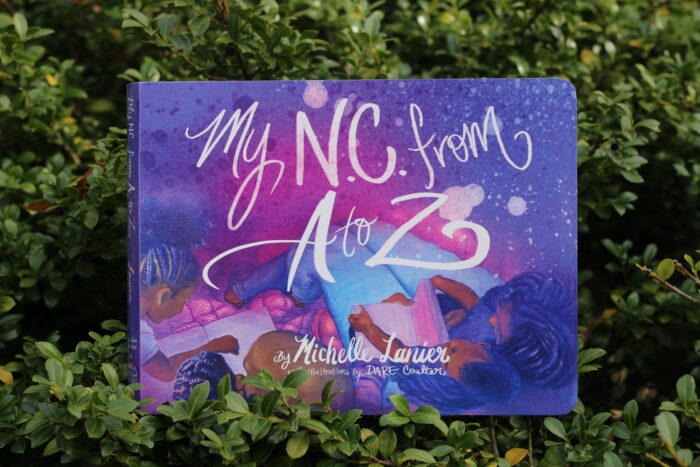
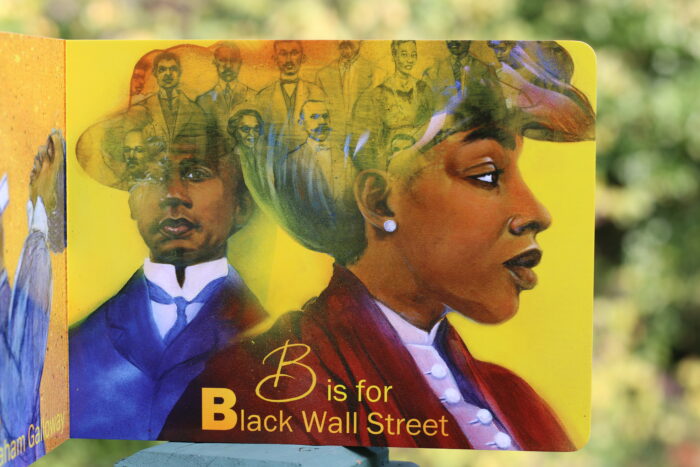
Michelle Lanier: It’s a very simple alphabet book, “My NC from A to Z.” And I really wanted there to be a board book that would have the alphabet being a portal into particularly the African-American experience of North Carolina. And so for L, the letter L, I chose “L is for Longleaf pine.” And it was important for me to acknowledge that if one is thinking about people of African descent whose ancestors were brought over on ships, turpentine, tar and pitch was a part of that story.
[MUSIC IN HERE]
Michelle Lanier: And there’s something … very moving to me when I consider that these first, um, laborers were made to extract a substance from a tree that was then sent to Europe to make more ships watertight in order that those ships might then go back to the continent of Africa and extract more human beings.
[MUSIC FADES OUT]
Leanna First-Arai: Wow. Yeah. In this moment, as we’re witnessing sort of the ongoing dismantling and kind of erasure of, of, histories and, you know, generations worth of of work in some of the fields that you are very active in, like, what sort of heightened level of importance has your work taken in this moment?
Michelle Lanier: I speak a language of hope. I am not in despair about the current moment. And, and frankly, I’m not even in despair about the past.
[MUSIC IN HERE]
Michelle Lanier: As someone who grew up in the U.S. South, seeing what fear can look like when it’s being used as the primary driver of policy, this is the life that I know very well, and so I feel very equipped to meet this moment.
Leanna First-Arai: Mm-hmm.
Michelle Lanier: And in times of great upheaval, in times of tumult and change, it is comforting to me to know that I can work collaboratively to archive this moment. It is a sacred trust keeping the memory of a place and of a people. This is the moment that we all train for every day.
Leanna First-Arai: Thank you so much for spending this hour with us, Michelle. Really an honor and a pleasure.
Michelle Lanier: Thank you for having me.
[MUSIC OUT HERE]
HOST: That was Michelle Lanier, the Director of North Carolina Historic Sites.
[BROKEN GROUND THEME MUSIC IN HERE]
HOST: That does it for this episode of Broken Ground. If you’d like to see some Longleaf pine photos or learn more about the turpentine or biomass industries, check out our website, Broken Ground Podcast dot o-r-g. There, you’ll also find links to SELC’s multimedia storytelling series, “Plantations to Pollution: Black Communities, Legacy Pollution, and the Path Forward.” Broken Ground is a podcast by the Southern Environmental Law Center, one of the nation’s most powerful defenders of the environment, rooted in the South. It’s produced by Emily Richardson-Lorente, Noa Greenspan, Jennie Dailey, and me, Leanna First-Arai. With special thanks to Ko Bragg, Sam Lenga and Pria Mahadevan. Our theme music is by Eric Knutson. If you enjoyed this episode, we’d love it if you’d write us a review on your favorite podcast app. See you next time.
[BROKEN GROUND THEME MUSIC OUT HERE]
BROKEN GROUND SEASON 8
EPISODE 2: TURPENTINE WITH MICHELLE LANIER
TRANSCRIPT
OCT. 22, 2025
[MUSIC IN HERE]
Michelle Lanier: If you are in a woodland space in North Carolina, you might stumble upon an old tree that still has that scar tissue from being bled.
HOST: In this episode of Broken Ground, we’re traveling back in time to learn about one of our region’s earliest, most environmentally destructive industries …
Dr. Albert Ike/Spirit of the Pines: It’s about pine trees and it’s about turpentine. But it’s really about people. It’s about the people who lived in these woods and camps and who made turpentine from these trees. What you will see and hear is both raw and real.
Michelle Lanier: The same way my people were pulled out of the continent of Africa and exploited for labor is the same way the pine trees are bled for income.
HOST: What scars did the turpentine industry leave? And in what ways does the industry still echo in our woodlands and communities today?
[MUSIC ECHOING, UP AND OUT]
[BROKEN GROUND THEME MUSIC IN HERE]
HOST: This is Broken Ground, a podcast by the Southern Environmental Law Center. I’m Leanna First-Arai, your host. Here at Broken Ground, we dig up environmental stories in the South, and introduce you to the people at the heart of them.
[BROKEN GROUND THEME MUSIC OUT HERE]
HOST: This season, we’re exploring the root causes of some of the environmental injustices communities face throughout our region. The digging continues online with SELC’s multimedia storytelling series “Plantations to Pollution: Black Communities, Legacy Pollution, and the Path Forward.” I hope you’ll check it out.
[SAWING/GRINDING/CONSTRUCTION SFX]
HOST: If you listened to our previous season, you already know that our Southern forests are under threat from the growing biomass industry. That’s the industry that grinds up trees and turns them into pellets to fuel power plants abroad. Not only is this terrible for our forests and our climate, it’s also pretty awful for the folks who now have to live with noisy, polluting pellet factories in their neighborhoods.
[MUSIC IN HERE]
HOST: But … this isn’t the first time our Southern forests have been exploited at the expense of the people living and working in them. Back in the 1800’s – across much of the same area now being ravaged for biomass – the turpentine industry began chewing through North Carolina’s native Longleaf pine forests. Fueled initially by slave labor and and then, essentially indentured African-American workers, this industry was not just brutal … it actually helped propel the transatlantic slave trade. And, as we’ll learn, it also has had a long-lasting impact on the landscapes in which we live today. We’ll come back to that shortly with the help of our guest.
[MUSIC OUT HERE]
Michelle Lanier: My name is Michelle Lanier. I am a keeper of memory, a writer, an educator, a filmmaker, and I’m a trained folklorist. Additionally, I’m someone with deep roots in North Carolina.
[MUSIC IN HERE]
HOST: Michelle is also the Director of North Carolina Historic Sites, which means she oversees 27 historically important locations around the state, including archaeological sites, a former plantation, and Civil War battle fields, among others.
Michelle Lanier: North Carolina, what is attractive to me is it’s, it’s a knot that you will never untie in terms of the layers and layers and layers of history. But that actually keeps me coming back and it keeps me excited to invite people in.
Leanna First-Arai: Michelle, in conducting our research for this episode, we came across a presentation you delivered titled “What the Land Witnessed.”
Michelle Lanier: Yeah.
Leanna First-Arai: Can you tell us more about the origin of that idea?
Michelle Lanier: I was a little girl who loved to wander about. So the concept of the land as being like a text that could be read in a tactile way was something that I understood very, very young.
Leanna First-Arai: Hmm.
Michelle Lanier: I’m thinking about a concept that I call ‘ecosystems of witness’ – what are the ecologies that were witness to my ancestors and other people who have ancestry in North Carolina – what the land itself witnessed.
[MUSIC OUT HERE]
Leanna First-Arai: One of the big questions that we’re grappling with throughout this season of the podcast is just looking at how understanding histories at sites across the region can help us better understand the anatomy of some of our social problems. How do you think about that question in terms of all of the histories that you are a steward of.
Michelle Lanier: If I’m thinking about the through lines of historic narratives to the current moment that we’re living in, there is, there’s nothing that we’re experiencing in the current moment that we can’t look to our past for some sort of food and medicine to carry us through.
Leanna First-Arai: Hmm. So, one of the topics that we’ve spent a lot of time kind of investigating on the podcast is the human and environmental impact of the wood pellet industry. According to pretty conservative estimates, we’re talking about a hundred thousand acres of southern forest that have been cleared every year for wood pellets. And one of the things that we’ve started to open up our thinking to is going back further than, than we had before, connecting now the biomass industry ills to the loss of native trees. I’ve heard you call that in some way ‘the predecessor story.’ Could you just unpack a little bit this predecessor story when we’re talking about what the land has witnessed over all of these generations?
Michelle Lanier: For millennia …
[MUSIC IN HERE]
Michelle Lanier: … before European contact and before the transatlantic slave trade as it impacts North Carolina specifically, we know that the Longleaf pine covered much of, of this land that we now call North Carolina.
Leanna First-Arai: Not everyone can conjure an image of Longleaf pine, so could you just quickly describe the Longleaf pine?
[MUSIC OUT HERE]
Michelle Lanier: You can imagine by its name, the needles are extremely long. Even when it is in its youngest phase of growth, when it is really just a little sapling, it looks like a green, kind of, bottle brush that has just lifted out of the ground. I often say that it looks like kind of a green – if you know the Cousin It character – as if it’s gonna walk towards you when it’s young. And then they grow very, very tall. If they’re left alone, they can grow extremely thick as well. And their pine cones are giant, like the size of a, a grownup’s head.
Leanna First-Arai: Wow.
Michelle Lanier: Huge pine cones. There are pine nuts, there are nuts inside of these pine cones. But there’s also medicinal uses for those needles. You could make teas from those needles. They’re very rich in vitamin C.
[MUSIC CREEPS IN HERE]
Michelle Lanier: And with Europeans coming in and settling in the 1600’s and 1700’s, they’re realizing that these trees are an incredibly powerful economic driver.
HOST: Because the Longleaf pines grew so straight and so tall – often more than 100 feet – they were prized for their lumber. But even more so than the wood or the pinecones or the needles, the pine product that Europeans – particularly the British navy – really clamored for in the 1800’s was what they called “naval stores.”
Michelle Lanier: The phrase “naval stores” because what is bled out of these pine trees – the liquid that is inside of them – is transmuted into turpentine, tar and pitch.
[MUSIC OUT HERE]
Michelle Lanier: And turpentine, tar and pitch are incredibly important to boats – the navy, the naval stores – makes these ships water tight. It is necessary. So barrels and barrels of turpentine, tar and pitch shipped over to Europe and then ultimately the northeastern United States where there’s a lot of shipbuilding that’s happening.
[DOCUMENTARY MUSIC IN HERE]
HOST: So many barrels were shipped, in fact, that by the mid 1800’s, the top three exports from the American South were cotton, tobacco … and naval stores.
Narrator/Suwanee Pine: From the living pine of the Deep South comes one of our most picturesque and important agricultural industries …
HOST: This is a clip from a 1940’s era documentary titled “Suwanee Pine.”
Narrator/Suwanee Pine: This industry presents a thrilling chapter in the story of American ingenuity and progress.
HOST: Its patriotic tone seems pretty discordant today, given what we know about naval stores’ impact on the land and its laborers, but it does speak to how important the industry was at the time.
Narrator/Suwanee Pine: From these pines comes the raw product called gum, the source of gum rosin and spirit of gum turpentine.
HOST: You’ve probably heard of turpentine. It’s that really strong-smelling liquid you can buy at the hardware store that can clean a paint brush or help thin out an oil-based paint. That liquid is made by heating – or ‘distilling’ – the sticky gum bled out of pine trees. In producing this episode, we’ve been genuinely surprised to learn just how many other items pine gum has been used to make over the years, including:
Lawrence: Shoe polish
Sarah: Adhesive tape.
Suwanee Pine Announcer: Insect powder.
Cedric: Linament for sore muscles.
Suwanee Pine Announcer: Soaps.
Kyle: Cigarette paper.
Paula: Axel grease.
Vernon: Antiseptic.
Suwanee Pine Announcer: Why, even waxed crayons contain gum products.
HOST: You could think of pine gum as the equivalent of petroleum today, which we use not just for fuel, but in fertilizers, pharmaceuticals, plastics and countless other products. Pine gum was equally multipurpose. And the vast majority of it came from native Longleaf pines growing right here in the South.
Narrator/Suwanee Pine: The United States produces about 75% of the total world supply of these important farm products. All of this comes from a group of eight southern states reaching from North Carolina to Texas.
HOST: Did you know that this is why North Carolina was nicknamed “the Tarheel state”?
[MUSIC IN HERE]
HOST: The pine tar produced by slowly burning Longleaf pine debris stuck to everything, including the laborers’ feet. Back then, “Tarheel” was meant as an insult, meaning, basically filthy, poor, maybe uncouth … but it has since come to be embraced by North Carolinians. Still, it’s a reminder that producing turpentine, tar and pitch was dirty and difficult work.
[MUSIC OUT HERE]
Michelle Lanier: You can imagine being out in woodland spaces, sometimes having encampments. You would have a tree in the process of harvest. They would make what’s called “cat eyes,” these cuts inside the tree that would not kill the tree, but would injure it so that it is bleeding. I call it bleeding.
Leanna First-Arai: Mm-hmm.
Laborers/Spirit of the Pines: Oh you? Ohh! Aw. Oh you?
Narrator/Spirit of the Pines: Each worker calls his special sound to the tallyman who keeps track of the work in progress.
Laborer/Spirit of the Pines: Oh you!
HOST: This sound is from “Spirit of the Pines,” a 1978 University of Georgia documentary that attempted to capture the last vestiges of the turpentine industry as it was dying out. In the film, one worker – a “chipper”– makes it clear just how dangerous hacking away at the trees to get the pine resin could be. It’s a little hard to understand, but he says, “You got to pray to keep from killing a man.”
Laborer/Spirit of the Pines: You got to pray to keep from killing a man. You got to pray to keep from cutting him and you got to pray for him not cutting you.
[MUSIC IN HERE]
HOST: And the danger didn’t end with the chipping of the trees. The barrels of sticky resin that were collected then had to be distilled in so-called “fire-stills.”
Michelle Lanier: You had fire for the extraction process, which meant that this was very explosive work. Um, you hear people talk about “fat wood.” It’s called fat wood because it’s saturated naturally with a liquid that’s very flammable. People use it even now if they’re trying to set a little fire. It being very flammable can be useful, but it also means that it’s very dangerous. So there were explosions, there were people who suffered critical injuries.
HOST: And the turpentine camps where workers labored were often very remote, as much as ten or even twenty miles from the nearest public road. So there was no easy trek into town to see the doctor.
[MUSIC OUT HERE]
Michelle Lanier: If someone needed to get treatment for a burn or for a gash from an injury of a log falling on you or a tree falling on you. Or if someone was running and put in stocks and had frostbite, there was not anesthesia to help if someone needed an amputation. And so the labor of producing these naval stores is incredibly dangerous and a real driver in the transatlantic slave trade.
[MUSIC IN HERE]
HOST: By 1860, just before the start of the Civil War, some 15,000 enslaved people labored not on cotton plantations but deep in the Longleaf pine forests across the South.
Michelle Lanier: Some of the first Africans that are brought to North Carolina are extracting what becomes turpentine, tar and pitch out of these Longleaf pine.
HOST: According to Tapping the Pines, a seminal book on the turpentine industry by Robert B. Outland, living conditions at these secluded turpentine camps were some of the worst that enslaved laborers endured. Shoddily built shacks, too little food, a scarcity of clean water, malarial mosquitos, saw palmetto that would slice through bare feet. And many camp owners didn’t hesitate to whip or otherwise punish their workers for perceived infractions – or for attempting to flee.
Michelle Lanier: There is a, a world of brutality people are experiencing at this moment in history that creates generations of trauma. And in many cases, people did not survive some element of that.
HOST: The brutality of the industry continued well after slavery was abolished at the end of the Civil War. In fact, in Georgia and Florida, prisoners – often arrested under trumped up “vagrancy” laws – were leased out to turpentine camps, where more than a few were worked, or beaten or shot to death by their overseers. But even, quote unquote, “free” people who labored in these camps were often effectively indentured servants.
[MUSIC OUT HERE]
Narrator/Spirit of the Pine: Turpentine camps were very paternalistic places.
HOST: This is from the film “Spirit of the Pines” again.
Narrator/Spirit of the Pine: Every camp had a commissary where workers could get provisions on credit. Debts were deducted each payday and many workers stayed tied to the producer by debt almost as effectively as during slavery.
[MUSIC IN HERE]
HOST: By 1920, half a century after emancipation, the vast majority of turpentine camp laborers were still Black men. And the vast majority of camp bosses and “woods riders” – men on horseback who surveilled the workers and kept them in line – were white. In addition to the human toll, the turpentine industry took a tremendous environmental toll.
Michelle Lanier: There came a, a, a moment where North Carolina’s, um, Longleaf pine was almost harvested into extinction.
HOST: Although “bleeding” the trees wasn’t MEANT to kill them, the resin would eventually stop flowing … at which point the trees would often be cut and sold for timber or pulp. That’s assuming, of course, that insects or drought or fire didn’t finish the weakened trees off first.
[MUSIC OUT HERE]
Michelle Lanier: As you see these forests being depleted, you see the moving of people from one part of the country to another, almost chasing the trees.
Leanna First-Arai: Interesting.
Michelle Lanier: And then behind that, you see other crops coming in. As one crop gets to a place where it’s no longer viable, then these same planters are saying, okay, then we need to do grain. Okay, then we need to do rice. Okay, we need to do cotton. Okay, we need to do tobacco. And then we see the soil becoming increasingly depleted with monoculture. We see drought, we see erosion. We see kudzu coming in as an erosion technology that then goes wild and is uncontrollable.
[MUSIC IN HERE]
HOST: The naval stores industry peaked around 1908, when producers extracted three-quarters of a million barrels of turpentine and two million drums of rosin. Given that the trees were also being harvested for timber, the Longleaf pine stood little chance of surviving. By the 1990s, 97% of our original Longleaf pine forest was gone, in many cases replaced by cropland. According to the Nature Conservancy, that level of ecosystem loss is one of the most significant EVER recorded, surpassing even the loss seen in the Amazon rainforest.
[MUSIC OUT HERE/IN HERE]
HOST: But … that wasn’t the end of the exploitation of the region’s forests and its people. Here at Broken Ground, we’ve noticed a number of disturbing parallels between the naval stores industry and what today is known as the biomass industry – specifically wood pellet manufacturing, which we covered last season. Today, the biomass industry is focused heavily on the Southeast, threatening much of the very same region targeted by the naval stores industry in the 19th and early 20th centuries. In fact, we layered an historic map showing the original range of Longleaf pine forests over a map of current biomass plants, and my goodness, there’s a LOT of overlap. That has resulted in a drastic change in the quality of life for people who live near pellet plants, and are forced to deal with the 24-hour a day noise and dust. Folks like Kathy Claiborne, who we visited last season at her home in Gaston, North Carolina, right next door to an Enviva pellet mill.
[MUSIC OUT HERE]
Kathy Claiborne: It’s like something is dropping in a machine and it’s, and it’s really loud, like BOOM! I guess my body now got adjusted to it, I can’t sleep at night.
[MUSIC IN HERE]
HOST: Another parallel between the two industries? What they leave behind. In short … not much. The author of “Tapping the Pines,” once described the extractive nature of the naval stores industry in this way: “Everywhere you see the naval stores industry,” he said, “it seems to center in areas that are poor, and when it leaves, it LEAVES those areas POOR … There’s no economic development … no businesses spun off from these backwoods operations.” Outland could just as easily have been talking about the biomass industry – at least according to the people that we’ve spoken with who live in pellet mill communities. There’s very little economic development in the wake of either industry, and with both, the forests themselves are sacrificed.
[MUSIC OUT HERE]
[SAWING/GRINDING/CONSTRUCTION SFX]
HOST: Just in the last decade over a million acres of southern forests have been cut and ground into pellets. If those trees are then replanted – and they often aren’t – in some cases they’re replaced by a single, fast-growing pine species that can be harvested again in as little as 10 years. In other words, you could argue that the biomass industry – like the naval stores industry before it – is replacing forests … with crops.
[MUSIC IN HERE]
HOST: These monoculture pine plantations not only reduce biodiversity – in terms of trees, birds, flowers, bugs, you name it – they also just, kind of, diminish the landscape.
[DRIVING SFX]
HOST: If you’ve driven through the rural South lately, you’ve probably seen a pine plantation or two. With trunks all packed together and little room for daylight to shine through, they aren’t much to look at. I’ve never heard anyone say THIS about a tree on a pine plantation:
Michelle Lanier: When I see a baby Longleaf pine, that’s all, you know, like, just resplendent in these long, gorgeous, bright green needles. And I see that it’s thriving and I see that, you know, some good land steward has done a controlled burn to clear the forest so that those turkeys come waddling in and eating the grubs that have been toasted by the fire and the woodpeckers come back. That, to me, is a sanctuary for my soul because it is a space that I can most beautifully speak to my ancestors because I know that that’s what the land looked like when they first came here.
[MUSIC OUT HERE]
Michelle Lanier: And that is worthy of contemplation, that’s worthy of getting in a train or a bus and getting closer to these spaces.
Leanna First-Arai: Mm.
[MUSIC IN HERE]
HOST: Since 1990, the Longleaf pine HAS had a small resurgence – rebounding from only about 3% of it’s original forests back up to almost 5%.
Michelle Lanier: Thankfully there was a lot of wisdom over the years, particularly as we get into the 20th century, around protecting the stands of Longleaf pine, those old growth stands that were still untouched.
HOST: As a public historian, Michelle Lanier says preserving the Longleaf pine is not just about preserving biological diversity, though that’s obviously very important.
[MUSIC OUT HERE]
Michelle Lanier: Because when we’re telling these stories about a time, it is most evocative if we can also invite our audiences into the experience of a space and a place. Not just through an artifact, which are important – things like quilts and cannons and clothing. All of this is very, very important. But the land itself is also a text. It’s a kind of living artifact.
Leanna First-Arai: Speaking of texts, you actually wrote a children’s book that mentions the Longleaf pine.
Michelle Lanier: Yes.
Leanna First-Arai: Can you tell us about that?
Michelle Lanier: It’s a very simple alphabet book, “My NC from A to Z.” And I really wanted there to be a board book that would have the alphabet being a portal into particularly the African-American experience of North Carolina. And so for L, the letter L, I chose “L is for Longleaf pine.” And it was important for me to acknowledge that if one is thinking about people of African descent whose ancestors were brought over on ships, turpentine, tar and pitch was a part of that story.
[MUSIC IN HERE]
Michelle Lanier: And there’s something … very moving to me when I consider that these first, um, laborers were made to extract a substance from a tree that was then sent to Europe to make more ships watertight in order that those ships might then go back to the continent of Africa and extract more human beings.
[MUSIC FADES OUT]
Leanna First-Arai: Wow. Yeah. In this moment, as we’re witnessing sort of the ongoing dismantling and kind of erasure of, of, histories and, you know, generations worth of of work in some of the fields that you are very active in, like, what sort of heightened level of importance has your work taken in this moment?
Michelle Lanier: I speak a language of hope. I am not in despair about the current moment. And, and frankly, I’m not even in despair about the past.
[MUSIC IN HERE]
Michelle Lanier: As someone who grew up in the U.S. South, seeing what fear can look like when it’s being used as the primary driver of policy, this is the life that I know very well, and so I feel very equipped to meet this moment.
Leanna First-Arai: Mm-hmm.
Michelle Lanier: And in times of great upheaval, in times of tumult and change, it is comforting to me to know that I can work collaboratively to archive this moment. It is a sacred trust keeping the memory of a place and of a people. This is the moment that we all train for every day.
Leanna First-Arai: Thank you so much for spending this hour with us, Michelle. Really an honor and a pleasure.
Michelle Lanier: Thank you for having me.
[MUSIC OUT HERE]
HOST: That was Michelle Lanier, the Director of North Carolina Historic Sites.
[BROKEN GROUND THEME MUSIC IN HERE]
HOST: That does it for this episode of Broken Ground. If you’d like to see some Longleaf pine photos or learn more about the turpentine or biomass industries, check out our website, Broken Ground Podcast dot o-r-g. There, you’ll also find links to SELC’s multimedia storytelling series, “Plantations to Pollution: Black Communities, Legacy Pollution, and the Path Forward.” Broken Ground is a podcast by the Southern Environmental Law Center, one of the nation’s most powerful defenders of the environment, rooted in the South. It’s produced by Emily Richardson-Lorente, Noa Greenspan, Jennie Dailey, and me, Leanna First-Arai. With special thanks to Ko Bragg, Sam Lenga and Pria Mahadevan. Our theme music is by Eric Knutson. If you enjoyed this episode, we’d love it if you’d write us a review on your favorite podcast app. See you next time.
[BROKEN GROUND THEME MUSIC OUT HERE]