
Tri-state water wars: Alabama, Georgia, Florida
Advocating for the long-term health of two major river basins
For the first time in 35 years, the states of Georgia, Alabama, and Florida are not currently in significant litigation over their shared river systems, historically known as the Tri-State Water Wars.
The three states share the Apalachicola-Chattahoochee-Flint (ACF) system, and Alabama and Georgia also share the Alabama-Coosa-Tallapoosa (ACT) system. Both of these massive watersheds originate in parts of north Georgia, including metro Atlanta. They also include downstream communities such as Rome and Columbus, GA, and Gadsden and Montgomery, AL. The ACF system empties into the Gulf at Apalachicola, FL, which is home to an important oyster shellfish industry. The ACT system forms a significant part of Mobile Bay in southern Alabama.
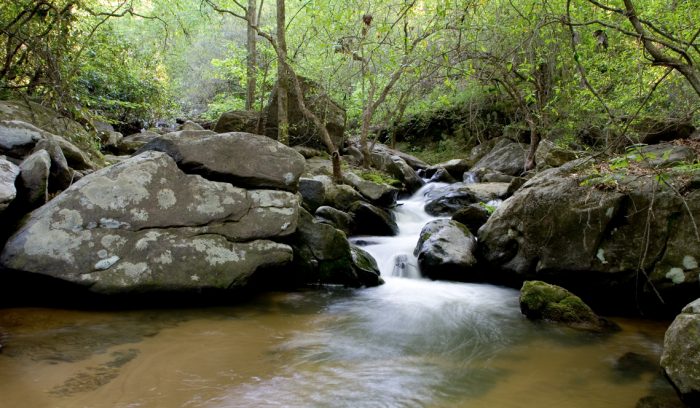
Because of Atlanta’s location at the tops of these river basins, conflict over these systems will continue to arise, particularly during times of drought. Metro Atlanta is growing and will require more water to sustain that growth. Meanwhile, Alabama, Florida, and downstream communities in Georgia are relying on sufficient clean water to reach them to meet current needs and allow for future growth.
Important watersheds for a growing South
These systems are complicated. In addition to providing municipal water supply, they also sustain agricultural and industrial uses. Southwest Georgia is home to an important agriculture industry that relies on the watersheds, especially in droughts. The river systems host a number of threatened and endangered aquatic species, whose populations are an important indicator of the systems’ overall health. Apalachicola’s oyster fishery experienced significant collapse due in part to insufficient fresh water coming through the ACF system, as well as intrusion of salt water from the Gulf. Many reservoirs exist up and down the systems, including Lakes Lanier and Allatoona in Georgia, which provide water supply and are managed by the U.S. Army Corps of Engineers. Other reservoirs are managed by Georgia Power and Alabama Power. The ACF and ACT systems have been further stressed in recent decades by historic droughts, which will only increase in frequency and duration as a result of climate change.

Beginning in 1990, the three states and the Army Corps of Engineers became involved in numerous lawsuits about how best to manage the system, and how much water should be allocated among the states. This litigation has played out in federal courts in Georgia, Alabama, Florida, and Washington, DC, and the U.S. Supreme Court has ruled twice on a suit between Florida and Georgia (ultimately finding that Florida did not adequately makes its case for more water). There were several years when the states attempted to form compacts to govern the river systems, but negotiations over both systems failed in the early 2000s. Even with all three states under Republican control over the past two decades, leadership has not been able to come to lasting agreement over how to share the water. The most recent settlement between Georgia, Alabama, and the Corps is taking effect now and calls for specific flow targets along the Chattahoochee River, but Florida was not part of that settlement.
Protecting a shared resource
SELC has monitored the progress of the litigation on behalf of a coalition of partner groups in all three states, and has weighed in at several points through friend-of-the-court briefs emphasizing the need to prioritize the overall health of the river systems while balancing different uses and needs. We have also used our experience in the Tri-State Water Wars to advocate for better water management policies in Georgia and Alabama. In Georgia, we succeeded in strengthening a historic water conservation law that put Georgia at the forefront of our Southern states when it was enacted in the late 2000s (however, we still need to do better in Georgia). Alabama is the only state in our region that lacks a statewide water management plan, and we continue to push for that as well as common-sense water management through permitting and other regulatory improvements.

While the litigation has dissipated for now, the underlying conflict is not going away. Atlanta continues to grow and strain the upper reaches of the ACF and ACT systems, and our downstream neighbors will continue to need their own fair share of water for ecological, recreational, agricultural, municipal, and industrial uses. All of this becomes more challenging in drought. SELC remains ready to advocate for healthy aquatic systems as future litigation and policy choices arise.
Additional Resources