

Alabama data center proposal moves forward
Updated November 19 to reflect the latest Bessemer City Council decision.
As data center growth shapes the South’s energy future, its overhype is well-documented. Although a community from just outside of Birmingham has united to send another proposal back to the drawing board, the Bessemer City Council just gave developers official approval to rezone for the widely contested project.
“Our community, the city of Bessemer, and other parts of Jefferson County will have to live with this reckless plan for years to come,” said Janice Sanders, President of the Red Mountain Heights Community Association. “We are left with more questions than answers—decisions of this magnitude should not happen behind closed doors.”
However, experts say it’s reasonable to believe that many of these energy hungry facilities proposed across the country will never be built, leaving customers on the hook for the onslaught of new methane gas facilities built to power them.
Customers don’t want higher utility bills, they want transparency and a chance to participate in big decisions affecting their neighborhoods.
“Project Marvel” causes concern
In Bessemer, Alabama, public officials and developers were shielding critical information about financial and environmental impacts of the hyperscale data center complex they called “Project Marvel.”
God’s most important rule is to love your neighbor as yourself. But data centers are anything but good neighbors.
Mary Rosenboom, Resident
It turned heads in West Jefferson County when a developer from Delaware asked to change a local zoning code to allow for such a project. The area the data center developer is eyeing is known best for its uninterrupted agricultural landscape.
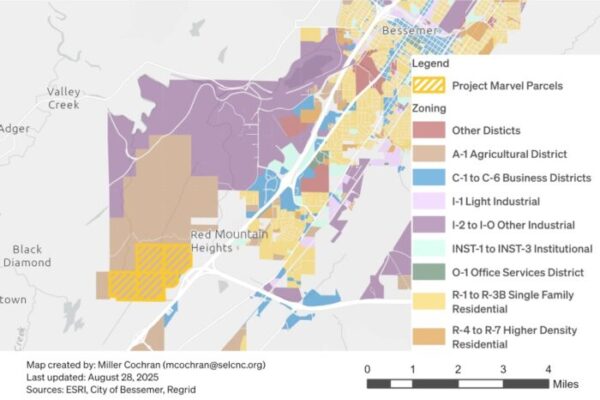


Project Marvel – Existing Zoning
The facts
Figures from the project’s original site plans:
- 18 server farms – each approximately the size of a Walmart Supercenter
- 100 acres of landscape to be developed
- 4.5 million square foot facility to be built
- 2 million gallons of water per day needed to operate it, at least
- 1,200 megawatts of electricity also needed for operation
- 760,000 Alabama residences could be powered by that same amount of energy
Some Bessemer elected officials have signed non-disclosure agreements with developers, and have not revealed how Project Marvel would impact the following for the surrounding community:
- Energy use: Some estimates say the project was expected to use 9 percent of Alabama Power’s capacity.
- Clean air and water: It would rely on fossil fuels that pollute our environment and accelerate climate change.
- Quality of life: Data centers aren’t good neighbors. The burden gets heavier the closer you live to one.
A crowded public meeting got loud when Bessemer’s City Council voted to send the data center project back to the planning and zoning commission. Residents celebrated this as a significant step toward getting their questions about the proposal answered.
“Building relationships with our neighbors and living in community is still a pillar of Southern culture for many people in our region,” says Staff Attorney and Birmingham resident Ryan Anderson. “But data centers haven’t earned that reputation.”
Watch the trailer.
For a glimpse of Project Marvel, press play on this Southern Exposure film from our partners at Alabama Rivers Alliance.
A community with questions
No one voted for data centers to take over their neighborhoods.
“God’s most important rule is to love your neighbor as yourself,” says resident Mary Rosenboom. “But data centers are anything but good neighbors.”
She has been actively seeking information about the data center proposed a mile away from her home since March.
The Mid-Atlantic-based developer claims operating the facility would take 2 million gallons of water, but where would it come from? The local water utility, Warrior River Water Authority, says it would need major upgrades to serve the facility. Residents want to know who will pay for those upgrades.
People have a right to transparency around major developments that put their communities at risk. It’s not a privilege.
Barry Brock, Alabama Office Director
Many other questions about the project’s effect on local communities remain unanswered, despite repeated requests for information.
Rosenboom has spent hours upon hours researching data center impacts across the country and making sure her neighbors know how the massive polluting facility could affect the wetlands flanking the site, their access to clean air, public health, the local economy, and more. One question continues to rise to the top of her list.
“If the project is so good for us, why are the city and developer shielding the details?” she asks. “If you don’t want us to make assumptions, give us facts.”
Transparency isn’t a privilege
We know utilities’ energy forecasting is inflated, and so do they.
Yet Alabama regulators are staying true to their pro-industry past as the Trump administration orchestrates its plans for more data centers and fossil fuels.
The Bessemer City Council’s original decision to pump the breaks on this proposal until the full impacts are assessed offers a blueprint for utilities, developers, and governments driven by profit.
“It’s going to be up to local decision-makers to be the back stop,” says Barry Brock, the director of SELC’s Alabama Office. “People have a right to transparency around major developments that put their communities at risk. It’s not a privilege.”
It’s not a controversial opinion that everyone deserves a say about local projects that could harm them.
SELC supports the people of Bessemer.