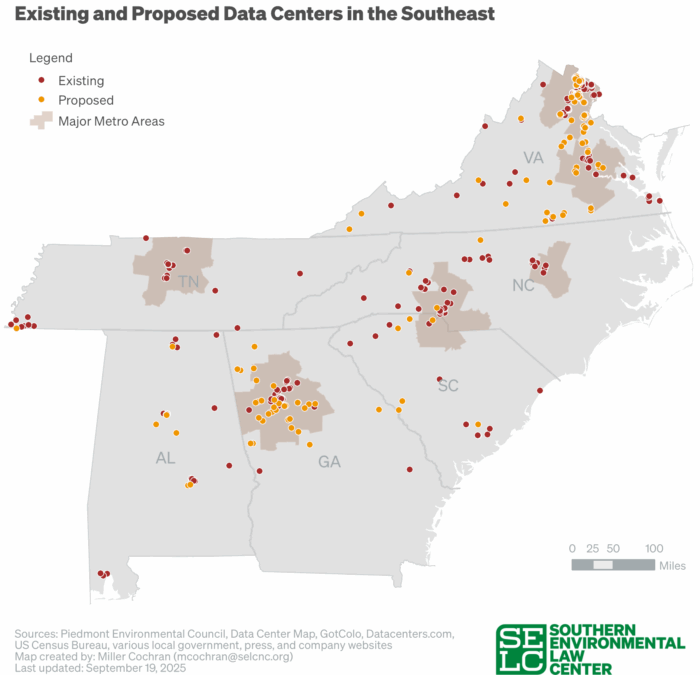
Data centers across the South
The South is experiencing a data center boom, raising concerns about how to provide energy to facilities that consume 10 to 50 times more energy than typical commercial buildings. While some data center companies tout their corporate clean energy goals, those goals are at risk when the utilities that supply their electricity are weaponizing projected growth in electricity demand to justify a massive buildout of methane gas power plants.
Without careful planning and innovative solutions, data center development and expansion will hinder our ability to meet state and federal climate goals, provide an excuse for electric utilities in our region to invest in more methane gas plants and put off retiring coal plants, and pass on increased costs to ratepayers.
What are data centers?
Data centers are large buildings that house computing machines and their related hardware equipment that organizations use to store, process, and distribute the digital information that is behind an ever-increasing number of services we all use every day.
In recent years, exploding demand for artificial intelligence and cryptocurrency have pushed development of data centers to record highs, raising concerns from environmental groups, communities, and utility providers due to the huge amounts of energy, water, and land they consume.
The South has become ground zero for data center development and expansion for many reasons, including its more affordable land and the generous tax incentives some states offer even though data centers typically don’t generate many permanent local jobs.
Energy and land use
While data centers provide valuable services, they can have significant negative environmental impacts for local communities, including noise, air pollution from back-up generators at the facilities, the large volumes of water needed for cooling, and the amount of land being paved over to build them. Because they use so much energy, they’ve become electric utilities’ number one justification for proposing new methane gas power plants. Data centers also present communities with the question of what will happen if development is started and either never completed or if tenants fail to enter the unleased space.
The growth in electricity demand from data centers is threatening the South’s transition away from fossil fuels and toward clean energy. Tech companies, utilities, policy makers and advocates must work together to ensure that this growth is sustainable and does not put climate progress at risk.
Gudrun Thompson, Energy Program Leader
Virginia, the data center capital of the world
Virginia is known as the data center capital of the world. The state is home to at least 600 data centers, with 90 percent of those in Northern Virginia. The state is also home to more than 35 percent of all known hyperscale data centers worldwide, according to the Virginia Economic Development Partnership. Hyperscale data centers are generally defined as those that are 10,000 square feet or more and typically use at least 100 MW of power.
In its 2024 Integrated Resource Plan (IRP) for the state, Dominion Energy said data center growth is driving record demand, with the utility claiming that this growth will require 6,000 MW of new methane gas power plants. Dominion’s claim should not be taken at face value, but it shows that utilities like Dominion view data centers as a huge opportunity to build expensive, polluting facilities—driving up our bills while dragging us backward on climate.
A key factor in the data center industry’s growth in Virginia has been the state’s available tax exemption. Virginia was an early adopter of such a policy in 2008 and has since expanded its scope to include a variety of data center types and provisions focused on capital investment, job development, and wage/earning thresholds. In its current form, the conditions for the incentive are minimal and data center companies can easily claim the exemption.
Charting a sustainable path for data center development in Virginia
– Op-Ed by Nate Benforado, Senior Attorney
Georgia data centers are on the rise
Since 2020, metro Atlanta has become the third fastest growing data center market in the country. The state’s largest utility, Georgia Power, says more than 90% of its projected “large load” growth comes from data centers. Georgia lawmakers attempted to manage this growth in 2024 by passing a law to eliminate certain tax breaks for data centers, as well as establishing a commission to study energy and water use, but the effort was vetoed by Georgia’s governor.
Early in 2024, the Georgia Public Service Commission (PSC) gave Georgia Power the go-ahead to bring more fossil fuel power plants online to support data center development in the state. The company has already deepened its customers’ reliance on volatile, climate-warming fossil fuels, and signaled it plans to break promised retirement dates of dirty coal plants and ask state regulators to burn significantly more methane gas to meet the growing data center need.
We’re pushing for responsible growth in Georgia and advocating for affordable and equitable clean energy solutions to support growing demand, including access to market-based community solar, battery storage, and expanding demand side management programs to lower energy use.
Tennessee
In Tennessee, xAI, a company founded by Elon Musk, opened a facility in the area in 2024. To meet the company’s massive power needs, it installed and operated unpermitted methane gas turbines, at one point having 35 of the polluting turbines on site.
These turbines are worsening air quality while continuing a legacy of environmental injustice in communities already forced to deal with industrial pollution from a utility-run gas plant, a steel mill, and an oil refinery.
Now, xAI is preparing to launch a second data center in South Memphis and is reportedly planning to rely on unpermitted methane gas turbines once again. SELC and our partners have pushed back on xAI’s use of turbines while also appealing the unlawfully lax permit issued by local health officials for xAI’s first South Memphis data center.
Changing the data center landscape
There may seem like no quick fix for slowing data center growth or ensuring that they do not stall the transition to clean energy. But one way forward is to hold energy regulators and developers accountable for the roles they play.
Big tech companies that build or use data centers need to put their corporate sustainability goals into action. They should leverage their status as large buyers of electricity to advocate for state policies and utility programs that help them achieve their decarbonization or clean energy goals. For example, they should demand that instead of building new gas plants, utilities meet their energy needs with portfolios of energy resources like solar, wind, and battery storage that deliver clean electricity around the clock. They should also engage with legislators and regulators to push for state policies that advance climate progress, like renewable portfolio standards or binding carbon-reduction targets.
Revisiting tax incentives should be a focus for lawmakers. With the data center craze in full swing, states can afford to be more selective in the types of data centers they want to attract. For example, lawmakers should consider tying the tax incentive to data centers that are committed to clean energy and use water as efficiently as possible.
Data centers should also be much more transparent about their resource needs and impacts and provide information to localities and resource managers about their energy and water sources and use projections, facility backup generation plans and site design. Localities should consider all of these impacts as part of public approval processes to ensure that consumers are protected, and not simply focus on the tax revenues that the facilities can bring to the locality or false promises of permanent jobs.
Utility commissions also need to be proactive in finding solutions to manage rapid data center growth and weed out speculative proposals. Commissions should place guardrails on large energy users like data centers to make sure they are paying their fair share and that the utility is not overcommitting itself to the detriment of its other customers. “Clean transition tariffs” that incentivize data centers to buy clean energy from the utility, or “bring your own clean energy” (BYONCE) programs that allow data center customers to power their own operations with new clean energy, should be instituted to ensure that data center growth does not worsen climate risks.